
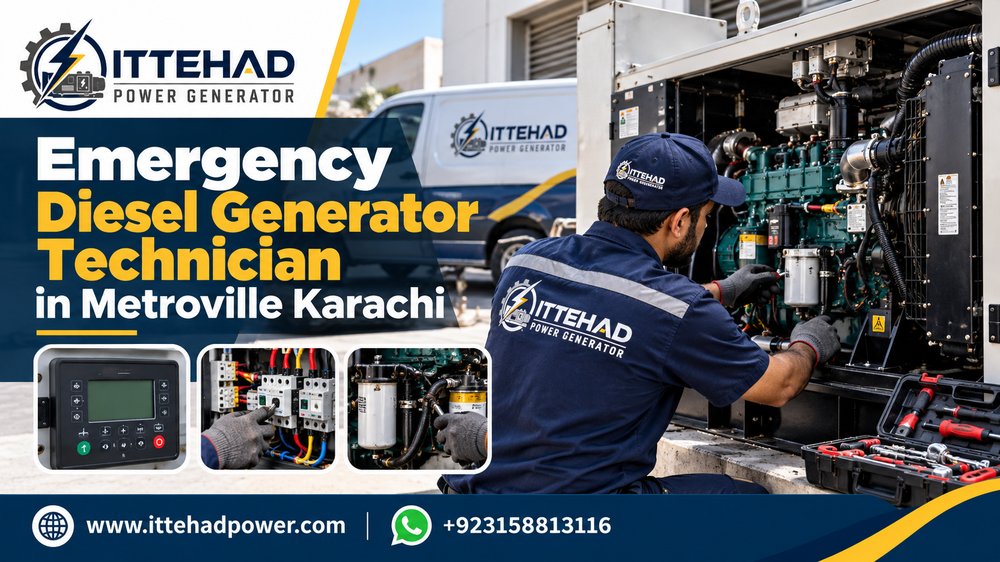
An emergency diesel generator technician in Metroville Karachi can help when a generator suddenly fails to start, shuts down unexpectedly, produces unstable output, shows warning alarms, overheats, develops fuel-related problems, or becomes unreliable during operation. Emergency generator faults require careful diagnosis because repeated starting attempts or random adjustments can make the problem worse. A systematic inspection can identify the likely cause, determine suitable corrective action, and help restore dependable generator operation as safely as possible.
When You Need an Emergency Diesel Generator Technician in Metroville Karachi
A diesel generator may require urgent technical attention when it cannot provide power as expected or shows signs of an electrical, fuel, cooling, starting, or control problem. The priority during an emergency should be to identify the fault accurately rather than replacing parts without testing.
Prompt inspection can be particularly important when the generator is expected to remain ready for backup operation. Early diagnosis may also prevent a smaller fault from developing into a more complicated repair.
Common Diesel Generator Emergency Problems
Generator emergencies can develop for many reasons. Some faults occur suddenly, while others result from conditions that have gradually become worse over time.
- Diesel generator not starting
- Generator starts but shuts down quickly
- Battery or cranking problems
- Fuel supply interruption
- Blocked or restricted fuel flow
- Overheating during operation
- Low oil or coolant warning
- Control panel fault indications
- Unstable generator output
- Unexpected shutdown alarms
- Loose or damaged electrical connections
- Unusual noise, vibration, or smoke
Why Fast Generator Fault Diagnosis Matters
During an emergency, the fastest repair is not always the one that involves immediately changing a component. Proper diagnosis can save time by identifying the actual source of the problem before corrective work begins.
For example, a generator that does not start may have a weak battery, loose electrical connection, fuel delivery issue, control fault, or another condition. Treating only the visible symptom may result in repeated failure.
Practical Checks During an Emergency Generator Inspection
A technician should begin with practical checks that help narrow down the fault without creating unnecessary risk. The exact inspection depends on the symptoms and generator condition.
Battery and Starting System
If the generator does not crank or turns over slowly, the battery and starting connections should be checked. Weak battery voltage, loose terminals, damaged cables, or starting circuit problems can prevent normal operation.
Fuel Supply
A diesel generator requires a consistent fuel supply. Fuel level, visible leakage, fuel lines, filters, and related connections may need inspection when the engine cranks but does not start or operates irregularly.
Oil and Coolant Levels
Low oil or coolant conditions can trigger warning or shutdown protection. Fluid levels and visible leakage should be checked before repeated attempts are made to run the generator.
Control Panel and Alarm Indications
Control panel warnings can provide useful information about the nature of the problem. Fault codes, shutdown messages, warning lights, and operating readings should be reviewed as part of the diagnosis rather than simply reset and ignored.
Electrical Connections
Loose, damaged, or overheated electrical connections can cause starting problems, control faults, unstable operation, or complete loss of generator output. Accessible wiring and terminals should be inspected carefully.
Diesel Generator Not Starting
A no-start condition is one of the most common reasons for requesting emergency generator support. The technician should determine whether the engine is not cranking, cranking slowly, or cranking normally without starting because each condition points toward different possible causes.
Potential areas for inspection include the battery, starter circuit, fuel delivery, control system, protective shutdown conditions, wiring, and related engine requirements.
Generator Starts but Shuts Down
A generator that starts and then stops may be responding to a protective condition or another operating problem. Repeatedly restarting the unit without identifying the cause can increase the risk of damage.
The technician may need to review warning indications, fluid levels, temperature conditions, fuel supply, sensor signals, electrical connections, and controller information to determine what is triggering the shutdown.
Overheating and Cooling Problems
Overheating requires prompt attention because continued operation at excessive temperature can affect generator reliability and engine condition. Low coolant, leakage, restricted airflow, damaged hoses, cooling system problems, or unsuitable operating conditions may contribute to excessive temperature.
The generator should be allowed to cool safely before components are inspected. Hot cooling systems should not be opened carelessly because pressurized coolant can cause injury.
Fuel-Related Generator Faults
Fuel supply problems can result in difficult starting, rough operation, loss of power, or unexpected shutdown. Diagnosis may include checking available fuel, visible leakage, fuel lines, filter condition, and whether fuel is reaching the engine correctly.
Replacing components without confirming the fuel restriction can increase repair costs without correcting the underlying issue. A systematic inspection is more effective.
Control Panel and Electrical Faults
Modern generator operation depends heavily on the control system. A controller may prevent startup or shut the generator down when it detects a fault condition.
Blank displays, repeated alarms, incorrect readings, non-responsive controls, or unexplained shutdowns may require checks of controller power, wiring, fuses, connectors, sensors, and related circuits.
Safe Inspection During a Generator Emergency
Emergency conditions can encourage rushed decisions, but electrical and mechanical safety should remain a priority. Diesel generators contain electrical circuits, hot components, moving parts, fuel, and battery connections that require appropriate handling.
- Keep hands away from moving components
- Avoid touching damaged electrical wiring
- Do not bypass protective shutdowns without proper diagnosis
- Do not open hot cooling systems immediately after shutdown
- Keep fuel away from ignition sources
- Use appropriate electrical isolation before working on connections
- Avoid repeated starting attempts when abnormal symptoms continue
Emergency Diesel Generator Troubleshooting Process
A structured troubleshooting process helps reduce unnecessary component replacement and makes emergency diagnosis more efficient.
- Confirm the exact generator symptoms.
- Review any warning lights, alarms, or fault messages.
- Check battery condition and starting response.
- Inspect fuel supply and visible fuel system condition.
- Check oil and coolant levels.
- Inspect accessible wiring and electrical connections.
- Review the control panel and protective shutdown information.
- Identify the likely source of the fault.
- Carry out suitable corrective work where possible.
- Test the generator after repair.
- Observe operation for repeated warnings or abnormal behavior.
Benefits of Professional Emergency Generator Support
Professional emergency support provides value by focusing on accurate diagnosis, safe inspection, and practical corrective action. The objective is to restore reliable generator operation while reducing unnecessary work.
- Faster identification of likely generator faults
- Reduced unnecessary parts replacement
- Safer electrical and mechanical inspection
- Improved chances of restoring dependable operation
- Clearer understanding of the fault and required repair
- Identification of developing issues during inspection
- Testing after corrective work
What Customers Need During a Generator Emergency
When a diesel generator stops working unexpectedly, customers usually need a clear assessment, practical repair guidance, and an understanding of whether the generator can be returned to service safely.
A professional technician should explain the identified problem, required corrective action, and whether additional repair or monitoring is advisable. Clear communication is especially important during emergency work because customers may otherwise approve unnecessary replacement based only on urgency.
How to Select an Emergency Diesel Generator Technician
Emergency generator service should be selected on technical capability and diagnostic approach rather than speed alone. Rapid attendance has limited value if the fault is not properly identified.
Look for Systematic Fault Diagnosis
A reliable technician should review the symptoms and test likely causes before recommending major component replacement.
Choose Safe Working Practices
Electrical connections, batteries, fuel systems, hot components, and moving parts require careful handling. Safety should remain part of the troubleshooting process even when the repair is urgent.
Ask for Clear Repair Recommendations
The technician should explain what has failed or what condition is causing the problem. Customers should understand why a particular repair or replacement is recommended.
Confirm Testing After Repair
After corrective work, the generator should be started and observed under appropriate conditions. The technician should check whether the original symptom, alarm, or shutdown condition has returned.
When Emergency Repair May Require Further Work
Some generator problems can be corrected during the initial visit, while others may require additional parts, deeper electrical testing, or further mechanical inspection. Temporary restoration should not be presented as a permanent repair when an underlying issue still requires attention.
A trustworthy technician should distinguish between an immediate corrective action and any additional work needed to restore full reliability.
Local Emergency Generator Support in Metroville Karachi
Generator owners in Metroville Karachi may need prompt technical assistance when backup equipment becomes unreliable or fails unexpectedly. Local support can make it easier to arrange inspection and determine whether the fault can be corrected on site.
On-site diagnosis also allows the technician to evaluate the generator under its actual operating conditions, including battery connections, fuel supply, ventilation, electrical wiring, control system, and surrounding installation environment.
Why On-Site Generator Diagnosis Can Be Valuable
Some generator faults are influenced by conditions outside the engine itself. Loose site wiring, restricted airflow, battery connections, fuel supply arrangements, or control wiring may contribute to the reported problem.
Inspecting the complete generator setup can help identify these external causes and reduce the chance of removing or replacing components that are still functioning correctly.
Trust Points in Emergency Generator Repair
Customers should receive practical technical support based on evidence rather than assumptions. A dependable emergency generator technician should focus on diagnosis, safety, transparency, and verification after repair.
- The reported symptoms are checked before parts are replaced
- Likely causes are inspected systematically
- Warning alarms are investigated rather than repeatedly reset
- Electrical and mechanical safety remains a priority
- Repair requirements are explained clearly
- Unnecessary component replacement is avoided
- The generator is tested after corrective work
- Further maintenance needs are identified when relevant
Guidance While Waiting for Generator Inspection
If the generator has developed a serious fault, avoid repeated starting attempts unless the cause is understood. Continuous cranking can discharge the battery and may place unnecessary stress on the starting system.
If there is visible fuel leakage, damaged wiring, excessive smoke, severe vibration, unusual mechanical noise, or overheating, the generator should remain stopped until the condition can be inspected safely.
Keeping note of any warning message, alarm code, unusual sound, smoke condition, or sequence of events before shutdown can also help the technician diagnose the fault more efficiently.
Preventing Repeat Generator Emergencies
After the immediate fault has been corrected, attention should be given to why the problem developed. Some emergencies result from sudden component failure, while others are connected to maintenance issues that could have been detected earlier.
- Keep the battery and terminals in good condition
- Check fuel availability and visible fuel system condition
- Monitor oil and coolant levels
- Respond to warning alarms promptly
- Inspect electrical connections periodically
- Keep ventilation paths clear
- Investigate unusual noise, smoke, or vibration early
- Arrange routine generator inspection instead of waiting for a breakdown
Why Corrective Action Should Match the Actual Fault
Effective emergency repair depends on identifying what has actually failed. Changing a battery will not correct a fuel restriction, and replacing a controller will not solve a loose power connection. Accurate fault isolation helps keep repair work focused and cost-effective.
The best corrective action may involve adjustment, securing a connection, replacing a confirmed faulty component, correcting fluid or fuel conditions, or performing further testing when the cause is not immediately visible.
Restoring Generator Operating Reliability
Emergency repair should not end as soon as the generator starts. Reliable operation should be confirmed by observing startup, controller indications, engine behavior, electrical performance, temperature, and any warning conditions relevant to the original fault.
If the problem returns during testing, further diagnosis is necessary. A generator that starts once but continues to show abnormal symptoms should not automatically be considered fully repaired.
Call an Emergency Diesel Generator Technician in Metroville Karachi
If your diesel generator will not start, shuts down unexpectedly, overheats, shows warning alarms, develops fuel or electrical problems, or becomes unreliable, an experienced emergency diesel generator technician in Metroville Karachi can help identify the likely cause and determine suitable corrective action.
Arrange an emergency inspection to have the generator checked systematically, from battery and fuel supply to controls, wiring, fluids, cooling, and operating condition. Accurate diagnosis, safe troubleshooting, and proper post-repair testing can help restore dependable generator operation and reduce the risk of the same fault returning.