
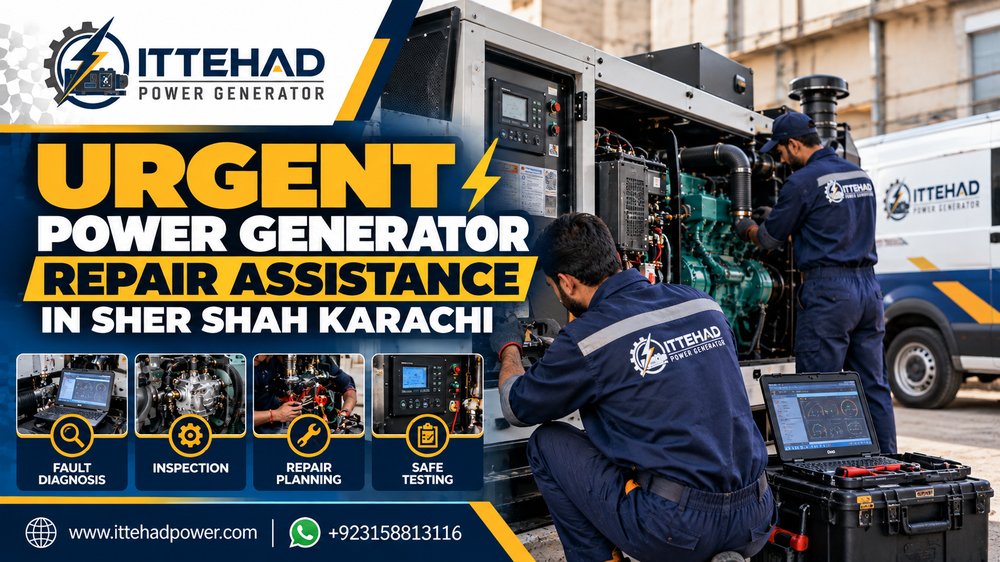
Reliable urgent power generator repair assistance in Sher Shah Karachi helps commercial and industrial generator users respond quickly when a unit fails to start, shuts down unexpectedly, overheats, loses electrical output, develops fuel problems, or shows warning indications during operation. Urgent repair should not mean random parts replacement or rushed adjustments. A professional response should combine fault diagnosis, systematic inspection, repair planning, safe testing, suitable corrective work, and post-repair verification so the generator can return to dependable service with greater operating confidence.
Why Urgent Generator Repair Support Matters
When a generator is required for important commercial or industrial power, an unexpected fault can immediately affect normal operations. Starting failure, unstable voltage, overheating, fuel interruption, or electrical shutdown can leave users without reliable backup power at the moment it is needed most.
Fast repair support helps reduce downtime, but speed should be combined with accurate diagnosis. Correctly identifying the fault at the beginning can prevent repeated breakdowns and unnecessary component replacement.
Urgent Power Generator Repair Assistance in Sher Shah Karachi
Professional urgent power generator repair assistance in Sher Shah Karachi should begin with a focused assessment of the reported symptoms and the generator’s current condition. The technician should determine whether the fault involves starting, fuel supply, cooling, lubrication, electrical output, control systems, batteries, wiring, or another critical area.
The objective is to restore reliable operation efficiently while avoiding temporary fixes that allow the same problem to return.
Start With Clear Fault Information
Accurate information from the generator user can save valuable diagnostic time. Before inspection begins, note exactly what happened when the fault appeared.
Useful Information to Provide
- Generator make and model
- Current operating hours
- Whether the generator starts
- Whether it shuts down after starting
- Any warning or fault indication
- Whether voltage output is available
- Whether the fault appears under load
- Any fuel, oil, or coolant leakage
- Recent repair or maintenance work
- Unusual noise, smoke, vibration, or temperature
Rapid Visual Inspection
An urgent generator inspection should begin with visible and easily accessible areas before deeper testing. This can reveal obvious faults that may be responsible for the shutdown.
- Battery terminals and cables
- Fuel level and visible fuel lines
- Engine oil level
- Coolant level
- Belts and hoses
- Electrical terminals
- Breaker condition
- Control-panel warnings
- Visible leaks
- Loose wiring or connectors
Generator Does Not Start
Starting failure is one of the most common reasons for urgent repair requests. A no-start condition can result from weak batteries, loose electrical connections, starter problems, fuel interruption, control faults, or engine-related issues.
Starting Failure Checks
- Battery charge condition
- Battery terminal tightness
- Cranking speed
- Starter operation
- Fuel availability
- Fuel-filter condition
- Fuel priming
- Control-panel status
- Emergency shutdown condition
- Related wiring and relays
Generator Cranks but Does Not Start
If the engine turns normally but does not start, attention often shifts toward fuel delivery, air in the fuel system, blocked filters, control signals, or engine-related conditions.
The technician should confirm that clean fuel is reaching the engine before more expensive components are suspected.
Generator Starts and Shuts Down
A generator that starts and then stops may be responding to a genuine protection condition or losing a required operating input.
Possible causes include low oil pressure, high temperature, fuel interruption, sensor faults, controller signals, battery charging problems, or an electrical protection event.
Fault codes and warning indicators should be reviewed before repeated restart attempts are made.
Unexpected Generator Shutdown
Unexpected shutdown during operation requires careful diagnosis because the generator may have stopped to protect itself from damage.
Possible Shutdown Causes
- Low oil pressure
- High coolant temperature
- Fuel starvation
- Overspeed or underspeed
- Low or high voltage
- Electrical overload
- Control-system fault
- Sensor or wiring problem
Do Not Keep Resetting Generator Alarms
Repeatedly clearing a fault code without identifying the cause can make the situation worse. Warning and shutdown systems are designed to indicate that an operating condition is outside the expected range.
The fault should be recorded and diagnosed before the generator returns to normal use.
Fuel Delivery Problems
Fuel-related faults can create difficult starting, power loss, rough running, or sudden shutdown. An urgent repair inspection should include the complete supply path where necessary.
Fuel System Inspection Points
- Fuel level
- Fuel quality
- Fuel filters
- Fuel hoses
- Air locks
- Fuel pump operation
- Fittings and clamps
- Visible leakage
- Return lines where applicable
Blocked Fuel Filters
A restricted fuel filter may allow the generator to start but prevent it from carrying normal load. As demand increases, engine speed may fall and the generator may lose voltage or shut down.
Filter condition should be checked before major fuel-system components are replaced.
Air Locks and Fuel Priming
Air entering the fuel system can cause repeated starting difficulty or unstable engine operation. This may occur after running out of fuel, filter replacement, loose fittings, or damaged suction-side hoses.
If air returns after bleeding, the entry point should be found rather than repeatedly priming the system.
Fuel Leakage
Visible fuel leakage requires prompt attention. Loose connections, damaged hoses, worn seals, or fittings can reduce reliable fuel supply and create an unsafe operating condition.
Fuel leaks should be corrected before extended generator operation continues.
Generator Overheating
High operating temperature is another common urgent fault. Overheating can result from low coolant, restricted radiator airflow, cooling fan problems, damaged belts, weak coolant circulation, or excessive load.
Cooling System Checks
- Coolant level
- Visible coolant leakage
- Radiator condition
- Cooling fan operation
- Belts and tension
- Hoses and clamps
- Water-pump area
- Ventilation around the generator
- Actual operating temperature
Do Not Continue Running an Overheating Generator
Repeated operation at excessive temperature can damage engine components, hoses, seals, wiring, and other systems.
The cause should be identified and corrected before the generator is returned to heavy load.
Low Oil Pressure Warning
Low oil pressure should be treated seriously. Possible causes include low oil level, poor oil condition, filter restriction, sensor problems, or internal lubrication issues.
The generator should not continue normal operation until the warning has been properly investigated.
Oil Leakage
Oil leakage can reduce lubrication level and may indicate deteriorating seals, loose fittings, damaged filters, or other engine problems.
Even a small leak should be checked if the generator is expected to run for extended periods.
No Electrical Output
A generator engine can run normally while producing little or no electrical output. Possible causes include breaker problems, AVR faults, excitation issues, alternator faults, loose terminals, or damaged output connections.
Voltage and frequency should be measured before internal electrical components are replaced.
Low Generator Voltage
Low voltage can result from excessive load, low engine speed, AVR problems, weak excitation, alternator condition, cable voltage drop, or loose electrical connections.
Frequency should be checked at the same time because it can help distinguish engine-speed problems from electrical regulation faults.
Unstable Voltage
Fluctuating voltage may point to AVR response problems, changing load, unstable engine speed, weak excitation, loose sensing wires, damaged terminals, or alternator issues.
Voltage instability should be diagnosed under realistic operating conditions whenever possible.
Generator Frequency Problems
Frequency is directly related to engine speed. Low or unstable frequency can indicate that the engine is unable to maintain the required speed.
Fuel delivery, air intake, governor response, electrical load, and engine performance may all need inspection.
Breaker Trips Under Load
A generator breaker may trip because of overload, short circuit, cable faults, internal electrical problems, or an incorrectly sized protection device.
Repeated trips should be investigated before the breaker is reset again.
Electrical Connection Problems
Loose or damaged electrical terminals can cause voltage drop, heat, unstable output, and intermittent operation.
Electrical Areas to Inspect
- Alternator output terminals
- Main breaker connections
- Cable lugs
- Grounding points
- AVR connections
- Sensing wires
- Control wiring
- Battery cables
Signs of Electrical Overheating
- Darkened terminals
- Melted insulation
- Burned cable lugs
- Electrical smell
- Discolored connectors
- Localized heat around terminals
Overheated connections should be repaired properly rather than simply tightened without checking their condition.
Battery and Charging Problems
Weak batteries can prevent emergency generator starting even when other systems are in good condition. Battery terminals, cables, charge condition, and charging performance should be checked during urgent no-start diagnosis.
A battery that repeatedly becomes discharged may have an underlying charging or electrical problem.
Control Panel Faults
The generator control panel can provide important information during urgent diagnosis. Fault codes, warning lights, voltage readings, frequency, temperature, and operating hours may all help narrow the problem.
Stored fault information should be reviewed before it is cleared where possible.
Sensor and Wiring Problems
A faulty sensor or damaged wire can sometimes trigger a shutdown even when the mechanical system itself is operating correctly.
Pressure, temperature, speed, and other control inputs should be tested where warning information does not match actual generator condition.
Repair Planning After Diagnosis
Once the cause is identified, the technician should decide which repairs are required immediately and which maintenance items can be planned separately.
A Practical Repair Plan Should Include
- Confirmed fault
- Affected system
- Required corrective action
- Replacement parts where necessary
- Testing procedure after repair
- Additional maintenance recommendations
- Monitoring points after return to service
Prioritize Critical Generator Faults
Problems affecting lubrication, cooling, electrical safety, fuel leakage, or severe overheating should receive immediate priority.
Operating a generator with a critical unresolved fault can increase repair cost and create additional damage.
Diagnosis Before Parts Replacement
Urgent repair pressure can sometimes lead to premature parts replacement. This should be avoided where practical.
A starting fault does not automatically mean the starter is defective, and low voltage does not automatically mean the AVR needs replacement. Testing should confirm the failed component before replacement.
Correct Spare Part Identification
If replacement parts are required, compatibility should be checked using generator model, engine details, part numbers, electrical ratings, or component specifications.
Installing an unsuitable component can delay the repair and create another fault.
Safe Generator Repair Procedures
Urgent repair should never ignore safety. Generator systems involve electrical energy, hot surfaces, moving parts, batteries, fuel, and pressurized fluids.
Electrical testing, fuel-system work, internal engine repair, and work near moving components should be carried out by qualified personnel using appropriate isolation and protective procedures.
Initial Testing After Repair
After corrective work, the generator should be started under controlled conditions. The technician should confirm that the original warning has cleared and the generator operates smoothly.
Post-Repair Checks
- Starting performance
- Engine sound
- Oil pressure
- Operating temperature
- Fuel, oil, and coolant leakage
- Voltage
- Frequency
- Control-panel warnings
- Vibration
Load Testing After Urgent Repair
A generator may appear repaired at no load but develop the same fault when electrical demand increases. Controlled load testing can help confirm that cooling, fuel supply, engine response, voltage, and frequency remain stable.
The generator should be tested within suitable operating capacity.
Check Generator Performance as Load Increases
Fuel restrictions, weak cooling, loose connections, and alternator problems can become more noticeable under higher electrical demand.
Voltage, frequency, temperature, and engine sound should be monitored as load is introduced.
Verify Temperature Stability
After overheating or cooling-system repair, the generator should run long enough to confirm that temperature remains controlled.
A short startup test may not reveal a problem that develops only after extended operation.
Verify Electrical Output
Electrical repair should be followed by voltage and frequency measurements. Output should remain stable as the generator carries suitable load.
Any continuing instability should be investigated before important equipment depends on the generator again.
Check for Leaks After the Generator Warms Up
Some fuel, oil, or coolant leaks appear only after pressure, vibration, and temperature increase.
Connections and repaired areas should therefore be inspected again after the generator has operated for a suitable period.
Benefits of Professional Urgent Generator Repair
- Reduced downtime: Focused diagnosis helps identify the problem efficiently.
- Better repair accuracy: Corrective work is based on actual fault findings.
- Reduced unnecessary parts cost: Components are not replaced only on assumption.
- Improved reliability: The root cause can be addressed rather than only the symptom.
- Safer return to operation: Critical systems are checked before normal use.
- Better operating confidence: Generator performance is verified after repair.
- Improved maintenance planning: Additional service requirements can be documented.
What Commercial and Industrial Generator Users Need
Commercial and industrial generator users need repair support that is responsive, technically accurate, and focused on restoring dependable operation. They also need clear communication about the fault, required parts, expected repair work, and post-repair testing.
A useful repair service should explain whether the generator can return to service immediately or whether additional maintenance is required first.
How to Select Urgent Generator Repair Support
Urgent repair assistance should be evaluated on diagnostic ability, safe working practices, technical coverage, and post-repair testing.
- Confirm that fault diagnosis is included.
- Ask whether starting, fuel, cooling, and electrical systems can be inspected.
- Confirm that parts will be replaced only after diagnosis.
- Ask whether voltage and frequency can be tested.
- Confirm that load testing is available where appropriate.
- Ask whether warning codes and control signals can be checked.
- Confirm that final operating checks are completed.
- Request clear maintenance recommendations after repair.
Avoid Choosing Emergency Repair Only by Lowest Price
The cheapest repair option may not provide good value if the original fault is not properly diagnosed or if testing is skipped.
Repair quality, technical capability, parts compatibility, and verification should be considered together with cost.
Local Relevance in Sher Shah Karachi
Commercial and industrial generator users in Sher Shah Karachi may operate equipment under demanding conditions involving heat, dust, long operating hours, changing load, and limited tolerance for unexpected downtime. These conditions can increase the importance of prompt fault diagnosis and reliable repair planning.
Local repair assistance can make it easier to arrange inspection, parts identification, corrective work, and post-repair testing when generator availability is important.
Heat and Urgent Generator Faults
High ambient temperature can expose cooling weakness, electrical overheating, battery stress, and fuel-system problems more quickly.
Generators showing repeated high-temperature warnings should receive cooling and ventilation inspection before normal operation resumes.
Dust and Generator Reliability
Dust can restrict filters, reduce radiator airflow, contaminate electrical areas, and increase operating temperature.
Air filters, radiator surfaces, alternator ventilation, and control areas should be inspected where dust exposure is significant.
Long Operating Hours and Repair Needs
Generators that run frequently can reach maintenance intervals quickly and may experience faster wear of filters, belts, hoses, batteries, and electrical connections.
Operating-hour records should be reviewed during urgent repair because overdue maintenance may contribute to the immediate fault.
Standby Generators Can Also Develop Urgent Faults
A generator with low operating hours can still fail because of battery discharge, fuel deterioration, corrosion, leaks, or lack of regular testing.
Standby equipment should therefore receive periodic inspection even when it is rarely used.
Repeated Generator Faults Need Deeper Investigation
If the same fault returns after previous repair, the underlying cause may not have been fully corrected.
Repeated battery failure, overheating, low voltage, fuel blockage, or breaker trips should lead to a broader inspection rather than repeated replacement of the same component.
Common Urgent Generator Repair Mistakes
- Repeatedly resetting fault alarms
- Replacing parts before diagnosis
- Continuing operation with overheating
- Ignoring fuel leakage
- Ignoring low oil pressure warnings
- Assuming every no-start fault is the battery
- Assuming every voltage fault is the AVR
- Skipping electrical connection inspection
- Testing only at no load
- Returning the generator to service without final checks
Trust Points for Professional Urgent Repair Assistance
A reliable urgent repair service should combine fast response with systematic diagnosis and safe testing.
- Clear fault assessment
- Complete inspection of relevant systems
- Diagnosis before parts replacement
- Correct spare-part identification
- Safe electrical and mechanical procedures
- Fuel and cooling-system checks
- Voltage and frequency verification
- Load testing where appropriate
- Post-repair leak inspection
- Clear maintenance recommendations
Prepare Useful Information Before Requesting Repair
Providing accurate information can help the repair team arrive better prepared.
- Generator make and model
- Engine model where available
- Current operating hours
- Exact fault symptoms
- Displayed alarm or fault code
- Recent service history
- Recent parts replacement
- Whether the fault occurs under load
- Visible fluid leaks
- Any unusual noise or smoke
Keep Generator Repair Records
Urgent repairs should be documented after the generator returns to service. Record the fault, inspection findings, parts replaced, electrical readings, repairs completed, and final test results.
Good records can make future troubleshooting faster and help identify recurring problems.
Preventive Maintenance After Urgent Repair
Once the immediate problem has been corrected, preventive maintenance can help reduce the risk of another unexpected failure.
- Track operating hours
- Check oil and coolant levels
- Inspect fuel filters
- Monitor battery condition
- Inspect belts and hoses
- Check for fluid leaks
- Monitor voltage and frequency
- Keep radiator airflow clear
- Review control-panel warnings
- Maintain clear service records
Post-Repair Monitoring
Generator behavior should continue to be observed during the first period of normal use after repair. Watch temperature, voltage, frequency, fuel supply, oil pressure, engine sound, vibration, and warning indicators.
If the original symptom begins to return, further diagnosis should be arranged before the fault becomes severe again.
Do Not Delay Repair When Warning Signs Are Clear
A small leak, weak battery, loose terminal, blocked filter, rising temperature, or unstable voltage can quickly become a complete generator failure if ignored.
Early attention can reduce secondary damage and make repair planning easier.
Restore Reliable Generator Performance in Sher Shah Karachi
Professional urgent power generator repair assistance in Sher Shah Karachi should combine rapid fault assessment, systematic inspection, repair planning, correct parts selection, safe testing, and performance verification. The goal is not simply to make the generator start again, but to restore dependable operation and identify the actual cause of the failure.
If your commercial or industrial generator will not start, shuts down unexpectedly, overheats, loses voltage, develops fuel problems, shows repeated warnings, or performs poorly under load, arrange an urgent professional inspection in Sher Shah Karachi. Accurate diagnosis, suitable corrective work, and controlled post-repair testing can help reduce downtime and restore reliable generator performance with greater operating confidence.