
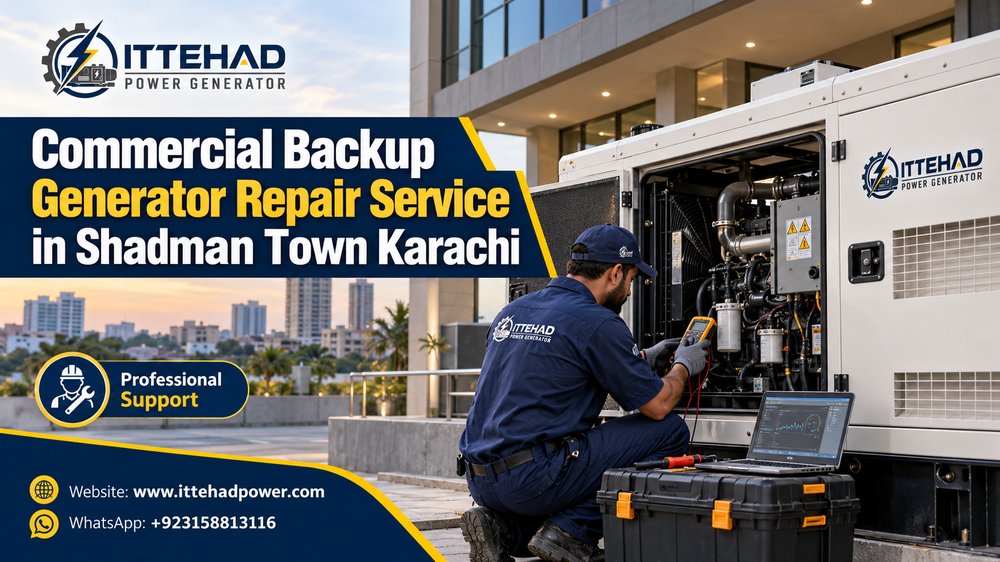
Professional commercial backup generator repair service in Shadman Town Karachi helps businesses restore dependable standby power when a generator develops starting problems, unstable operation, electrical faults, overheating, fuel-system issues, warning alarms, or shutdown conditions. Commercial backup generators are expected to operate reliably when needed, so repair should begin with structured fault diagnosis, detailed inspection, practical repair planning, safe testing, and confirmation that the generator can perform properly under its intended operating load.
Why Commercial Backup Generator Repair Service in Shadman Town Karachi Matters
A commercial backup generator may remain unused for long periods and then be expected to start immediately when required. If battery condition, fuel delivery, cooling, electrical connections, control systems, or engine components have deteriorated, the generator may fail at the moment backup power is needed.
Timely diagnosis and repair help identify developing problems before they become complete failures. A professional approach also reduces unnecessary parts replacement and focuses repair work on the actual cause of the fault.
Common Commercial Generator Faults
Commercial backup generators can develop faults in several systems. Some problems are obvious, while others appear only during startup or when electrical load is applied.
- Generator does not start
- Engine cranks slowly
- Engine cranks but fails to run
- Generator starts and shuts down
- Low or unstable voltage
- No electrical output
- Breaker trips under load
- High temperature warning
- Battery or charging fault
- Fuel delivery problem
- Control-panel alarm or fault code
- Unusual noise or vibration
- Oil or coolant leakage
- Poor performance under electrical load
Start with Accurate Fault Diagnosis
Commercial generator repair should begin by identifying the actual fault rather than replacing components based only on symptoms. Different problems can create similar operating behavior, so testing is essential.
For example, a generator that does not start may have a weak battery, poor cable connection, starter-circuit fault, fuel problem, shutdown signal, or control issue. Accurate diagnosis helps determine which system requires repair.
Generator Starting Problems
Starting faults are among the most common reasons commercial backup generators require service. The diagnostic process should determine whether the generator is not cranking, cranking slowly, or cranking normally but failing to start.
No Cranking
If the engine does not turn, battery condition, terminals, starting circuit, relay, wiring, control signal, and starter components may require inspection.
Slow Cranking
Slow cranking can indicate a weak battery, high-resistance cable connection, starter problem, or excessive mechanical resistance.
Cranks but Does Not Start
If the engine cranks normally but does not run, fuel supply, fuel filtration, air entry, shutoff controls, sensors, or engine-related conditions may need further diagnosis.
Battery and Charging System Repair
A reliable battery is essential for commercial standby-generator starting. Battery deterioration, corroded terminals, loose connections, charging faults, or electrical drain can cause repeated startup problems.
Battery voltage, cable condition, terminals, charging performance, and starting response should be checked before replacing major starting components.
Fuel System Inspection and Repair
Fuel-system problems can cause difficult starting, rough running, unstable engine speed, power loss, or shutdown under load.
A proper inspection may include fuel level, filters, lines, fittings, leakage, air entry, and fuel-delivery components.
- Check fuel availability
- Inspect fuel filters
- Review fuel lines and connections
- Check for visible leakage
- Look for air entering the fuel system
- Inspect shutoff controls where applicable
- Confirm fuel delivery during operation
Electrical Output Problems
A commercial generator can run mechanically while still failing to provide suitable electrical output. Low voltage, high voltage, unstable voltage, or no output requires electrical testing.
Diagnosis may involve the alternator, voltage regulator, excitation system, breaker, wiring, terminals, engine speed, and connected electrical load.
Low Voltage
Low generator voltage can result from overload, regulator faults, weak excitation, poor connections, alternator problems, or unstable engine speed.
High Voltage
High output may indicate sensing or voltage-regulation problems and should be corrected before continued commercial use.
No Electrical Output
No output can involve breaker condition, alternator excitation, regulator behavior, wiring faults, or internal generator problems.
Generator Breaker and Load Faults
A generator that trips when commercial load is connected may be overloaded or may have a breaker, wiring, protection, or connected-load fault.
Actual current should be measured and compared with generator capacity before the breaker is blamed or changed.
Overload Conditions
If electrical demand exceeds suitable generator capacity, protective devices may trip to prevent damage.
Breaker Condition
A weak, overheated, or damaged breaker can sometimes trip below its expected operating level and should be evaluated during diagnosis.
Cooling System Faults
Commercial backup generators produce more heat as electrical load increases. Low coolant, radiator blockage, poor airflow, fan problems, worn belts, damaged hoses, thermostat faults, or water-pump issues can cause overheating.
A generator that runs normally without load but overheats during commercial operation should have both cooling performance and load condition checked.
High Temperature Shutdowns
Repeated high temperature shutdowns should not be ignored or repeatedly reset. Cooling-system condition, coolant level, airflow, radiator performance, fan operation, and electrical load should be reviewed.
Safe testing after repair is necessary to confirm that temperature remains stable under suitable operating conditions.
Oil and Lubrication Faults
Low oil level, poor oil condition, leakage, sensor problems, or lubrication-related faults may trigger alarms or shutdowns.
Oil warnings should be verified carefully because operating with a genuine lubrication problem can cause serious engine damage.
Control Panel and Alarm Diagnosis
Generator control panels can provide useful information through warning lights, shutdown messages, operating values, and fault codes.
These indications should guide diagnosis but should not be treated as a substitute for physical inspection and testing. Clearing the warning without correcting the cause can allow the same fault to return.
Sensor and Wiring Problems
Temperature, oil, speed, and other sensors help the generator control system monitor operation. Faulty sensors, damaged wiring, loose connectors, or corroded terminals can create false warnings or unnecessary shutdowns.
Sensor circuits should be tested when the displayed condition does not match actual generator behavior.
Loose and Overheated Electrical Connections
Loose electrical connections can create resistance, heat, voltage drop, and intermittent faults. Commercial generators may appear normal at low load while connection problems become more serious as current increases.
- Inspect generator output terminals
- Check breaker connections
- Review battery cables
- Inspect cable lugs
- Look for discoloration
- Check for burnt insulation
- Inspect neutral and grounding connections where applicable
Engine Speed and Frequency Problems
Generator frequency depends on engine speed. If the engine slows excessively, hunts, or becomes unstable under load, electrical output can also become unstable.
Possible causes can include fuel delivery problems, governor issues, excessive load, mechanical condition, or control faults.
Commercial Generator Repair Diagnosis Process
A structured diagnostic process helps reduce guesswork and ensures the repair plan addresses the real fault.
- Confirm the reported generator symptoms.
- Review when and how the fault occurs.
- Inspect the generator visually.
- Check battery and starting condition.
- Inspect fuel supply and visible leakage.
- Review oil and coolant condition.
- Check control-panel alarms and fault messages.
- Measure voltage, frequency, and current where required.
- Inspect wiring, terminals, and electrical connections.
- Test suspected components.
- Confirm the actual fault.
- Prepare the appropriate repair plan.
- Complete corrective work.
- Test the generator after repair.
- Verify performance under suitable commercial load.
Why Visual Inspection Is Important
A detailed visual inspection can reveal useful clues before deeper testing begins. Loose wires, cracked hoses, leaking fluids, burnt terminals, worn belts, damaged connectors, and corrosion can help narrow the fault quickly.
This first stage can also identify conditions that require immediate attention before the generator is started or load-tested.
Repair Planning After Diagnosis
Once the problem is confirmed, the repair plan should focus on the parts and systems actually responsible for the fault. The required work may involve cleaning, adjustment, wiring repair, servicing, component replacement, or correction of an installation issue.
Related components should also be inspected so the generator is not returned to service with another developing problem.
When Generator Parts Need Replacement
Replacement is appropriate when a component is confirmed to be worn, damaged, leaking, electrically defective, mechanically failed, or unable to perform its required function.
Replacement parts should be compatible with the generator’s specifications and operating requirements. Similar appearance alone does not confirm suitability.
Why Trial-and-Error Repair Should Be Avoided
Replacing several parts without diagnosis can increase downtime and repair cost while leaving the original fault unresolved.
Testing first helps determine whether the problem is mechanical, electrical, fuel-related, cooling-related, or connected to the commercial load.
Safe Generator Repair and Testing
Commercial generator repair can involve electrical output, batteries, fuel, hot surfaces, moving components, and rotating machinery. Safe working procedures should therefore be followed throughout diagnosis and repair.
Live electrical testing and internal repairs should be handled by personnel with appropriate generator and electrical experience.
Post-Repair Testing
Repair is not complete until the generator has been tested after corrective work. The purpose of testing is to confirm that the original fault has been resolved and that no new problem has been introduced.
Testing can include starting response, engine stability, voltage, frequency, temperature, alarm status, leakage, noise, and performance under suitable load.
Why Commercial Load Testing Matters
Some generator faults only become visible when real electrical demand is applied. A generator may start and idle normally but experience voltage drop, overheating, speed instability, breaker trips, or warning alarms under load.
Suitable post-repair load testing provides stronger confirmation that the generator is ready to resume backup duty.
Benefits of Professional Commercial Generator Repair
Professional repair helps restore generator reliability while reducing unnecessary component changes and repeat breakdowns.
- Identifies the actual source of the fault
- Reduces unnecessary parts replacement
- Supports reliable backup starting
- Improves electrical output stability
- Helps prevent repeated shutdowns
- Identifies related developing faults
- Supports safer commercial operation
- Improves maintenance planning
What Commercial Customers Need from Generator Repair
Commercial customers usually need a clear diagnosis, practical repair plan, dependable testing, and confidence that the generator can support the required backup load after service.
They also need to understand whether the fault is limited to one component or related to a wider issue such as load, ventilation, fuel supply, electrical distribution, or maintenance condition.
How to Select a Commercial Backup Generator Repair Service
A reliable repair provider should offer complete fault diagnosis rather than simply replacing the most obvious component.
Choose Diagnosis Before Replacement
The technician should identify the actual fault before major parts are ordered or replaced.
Ask for Electrical Testing
Voltage, frequency, current, and breaker condition should be checked where the reported fault involves electrical output or load.
Look for Mechanical and Electrical Capability
Commercial generator faults often involve more than one system, so both engine and electrical conditions should be considered.
Confirm Compatible Parts
Replacement components should match the generator’s technical requirements.
Ask for Post-Repair Load Testing
The generator should be verified under suitable operating demand before being returned to regular backup service.
Customer Selection Tips for Better Repair Results
A good repair service should explain findings clearly and connect the recommended work to the actual generator fault.
- Ask whether a complete inspection will be performed
- Confirm control-panel alarms will be checked
- Ask whether electrical measurements will be taken where needed
- Confirm related systems will be inspected
- Ask whether the generator will be tested under load after repair
Local Commercial Generator Repair in Shadman Town Karachi
Commercial generator installations in Shadman Town Karachi can differ in electrical load, operating schedule, available ventilation, installation space, maintenance history, and connected distribution system. These conditions can influence how faults develop and how they should be repaired.
On-site diagnosis allows the generator to be tested under the same conditions in which the commercial fault normally appears.
Why On-Site Diagnosis Can Improve Repair Accuracy
Some faults are difficult to reproduce away from the installation. Breaker trips, overload conditions, ventilation problems, unstable electrical distribution, and intermittent wiring faults may only appear during normal site operation.
Testing the generator within its actual setup can help distinguish between generator failure and site-related conditions.
Trust Points in Professional Commercial Generator Repair
Reliable repair should be based on evidence, suitable parts, safe working practices, and clear post-repair verification.
- Fault diagnosis is completed before major replacement
- Battery, fuel, cooling, and electrical systems are reviewed where relevant
- Control-panel warnings are investigated
- Electrical measurements are taken where needed
- Compatible replacement parts are used
- Unnecessary repairs are avoided
- The generator is tested after repair
- Commercial load performance is verified where appropriate
Common Commercial Generator Repair Mistakes to Avoid
Incorrect repair decisions can increase downtime and allow faults to return.
- Replacing parts based only on symptoms
- Repeatedly clearing alarms without diagnosis
- Ignoring battery and charging condition
- Overlooking fuel restrictions
- Ignoring loose electrical connections
- Resetting breakers repeatedly without checking load
- Continuing operation with overheating warnings
- Changing protection settings without investigation
- Using incompatible replacement components
- Skipping load testing after repair
Guidance When a Commercial Backup Generator Develops a Fault
Record what happened when the fault appeared. Note whether the generator failed during startup, after load was applied, after running for some time, or while a warning alarm was active.
Do not repeatedly restart the generator if there is heavy fuel or coolant leakage, severe overheating, burning odor, visible electrical damage, or abnormal mechanical noise. These symptoms should be inspected before normal operation resumes.
Preventive Steps That Can Reduce Commercial Generator Faults
Routine inspection can identify developing problems before the generator is required during a backup-power event.
- Maintain battery and charging condition
- Inspect fuel filters and fuel supply
- Check engine oil and coolant levels
- Keep radiator and ventilation areas clear
- Inspect electrical terminals and cables
- Investigate warning alarms promptly
- Review generator load periodically
- Record maintenance and recurring faults
When Commercial Generator Repair Needs Prompt Attention
Prompt repair is recommended when the generator fails to start, repeatedly shuts down, trips under normal commercial load, overheats, produces unstable voltage, leaks fuel or coolant, or displays recurring fault alarms.
Addressing these problems early can reduce the risk of a smaller fault developing into a more extensive generator failure.
Restoring Reliable Commercial Backup Performance
A successful commercial generator repair should restore dependable starting, stable engine operation, suitable electrical output, proper temperature control, and normal protective functions.
Final testing should confirm that the generator can support its intended load without repeating the original fault, shutdown, warning, or instability.
Arrange Commercial Backup Generator Repair Service in Shadman Town Karachi
If your backup generator has starting trouble, unstable output, overheating, repeated alarms, breaker trips, fuel-system problems, or poor performance under load, professional commercial backup generator repair service in Shadman Town Karachi can help identify the cause and determine the correct repair approach.
Arrange a complete generator inspection before recurring faults affect backup-power reliability. Accurate diagnosis, practical repair planning, compatible replacement parts, safe testing, and post-repair load verification can help restore dependable commercial generator performance.