
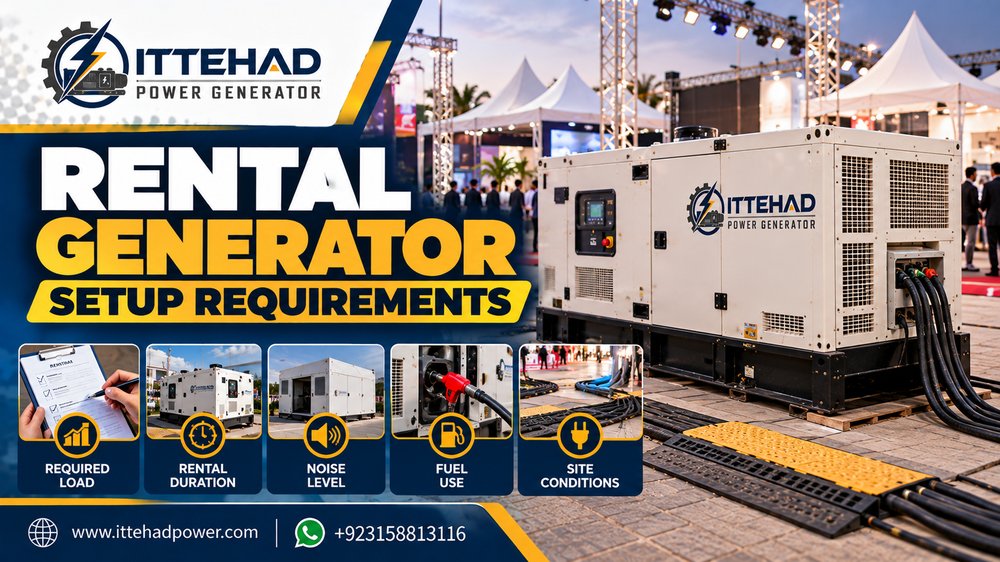
Understanding rental generator setup requirements helps commercial and industrial generator users arrange temporary or backup power more safely, efficiently, and reliably. A rental generator should not simply be delivered and switched on without reviewing electrical load, rental duration, noise level, fuel use, site conditions, cable requirements, ventilation, grounding, access, and backup-power expectations. Proper setup planning can reduce overload risk, prevent voltage problems, improve fuel management, simplify operation, and provide greater confidence throughout the rental period.
Why Rental Generator Setup Requirements Matter
A rental generator may be temporary equipment, but its electrical and operating requirements are just as important as those of a permanently installed unit. Poor positioning, unsuitable cable sizing, incorrect capacity, restricted ventilation, or incomplete fuel planning can create avoidable problems during operation.
A structured setup process helps ensure that the generator is suitable for the intended load, can operate safely at the selected site, and has the supporting equipment needed for reliable temporary power.
Rental Generator Setup Requirements Before Delivery
Before a generator arrives, the most important rental generator setup requirements should already be reviewed. This allows the correct generator size, cable arrangement, fuel plan, and site position to be prepared in advance.
- Expected electrical load
- Required generator capacity
- Voltage and phase requirement
- Rental duration
- Daily operating hours
- Noise considerations
- Generator placement area
- Ventilation and exhaust conditions
- Cable distance
- Fuel access
- Grounding requirements
- Backup-power reliability needs
Start With an Accurate Electrical Load Assessment
Generator capacity should be selected according to the actual electrical demand that needs to be supplied. Guessing the required size can result in either an undersized generator that struggles under load or an unnecessarily large unit that increases rental and fuel costs.
Prepare a list of all electrical equipment expected to operate from the rental generator and identify which loads may run at the same time.
Load Information to Prepare
- Normal running load
- Maximum simultaneous demand
- Starting loads
- Essential electrical equipment
- Single-phase or multi-phase requirements where applicable
- Expected future load additions
- Approximate operating schedule
Consider Starting Load, Not Only Running Load
Some electrical equipment requires more power during startup than during normal operation. Motors, compressors, pumps, and certain other loads can create a temporary demand that is several times higher than their running requirement.
The rental generator should have enough capacity to handle these short starting peaks without severe voltage drop or unstable frequency.
Avoid an Undersized Rental Generator
An undersized generator may operate normally when only a few loads are connected, then struggle as electrical demand increases. This can result in voltage drop, frequency changes, breaker trips, overheating, or unexpected shutdown.
Generator capacity should include a practical margin above the calculated operating load.
Avoid Excessive Generator Oversizing
Selecting a much larger generator than necessary can increase fuel consumption and rental cost without improving the actual power requirement.
The goal should be suitable capacity, not maximum available capacity. Accurate load information helps achieve a better balance between reliability and cost control.
Confirm Voltage and Phase Requirements
The rental generator must match the electrical system it will supply. Voltage, frequency, and phase configuration should be confirmed before delivery.
Incorrect electrical configuration can delay setup and may prevent connected equipment from operating correctly.
Determine the Rental Duration
The expected rental period influences fuel planning, servicing, operating supervision, and generator selection. A unit required for a few hours may have different support needs from one expected to operate continuously for several days or longer.
Rental Duration Questions
- How many days is the generator required?
- How many hours per day will it operate?
- Will it run continuously or only when needed?
- Will setup and testing time be included?
- Could the rental period be extended?
- Will servicing be required during the rental?
Plan for Long Operating Hours
A generator operating for extended periods can accumulate service hours quickly. Oil, filters, coolant, belts, and other maintenance items may require attention during a longer rental period.
Maintenance responsibilities should be clarified before the generator begins operation.
Choose a Suitable Generator Location
Generator placement affects cooling, cable distance, noise, exhaust safety, refueling access, and maintenance. The unit should be positioned on a stable surface with enough clearance around it for normal operation.
Generator Site Requirements
- Stable ground or platform
- Delivery and removal access
- Adequate ventilation
- Safe exhaust direction
- Reasonable cable distance
- Fuel access
- Maintenance clearance
- Protection from accidental contact
- Space for safe operation
Ventilation Requirements
A running generator produces substantial heat and needs sufficient airflow for combustion and cooling. Restricted ventilation can cause temperature to rise and reduce operating reliability.
The generator should not be placed where hot radiator air becomes trapped or repeatedly recirculates back into the cooling system.
Exhaust Positioning
Generator exhaust should discharge away from occupied areas, doors, windows, ventilation openings, and locations where fumes can accumulate.
Exhaust direction should be considered before the generator is positioned so that later relocation is not required.
Noise Level Considerations
Noise can be an important part of rental generator setup, especially where the unit operates near occupied or working areas. Generator design, enclosure, load, exhaust, surrounding surfaces, and distance all influence perceived sound levels.
Where noise matters, positioning and equipment selection should be considered together with cable distance and ventilation.
Plan Cable Length Before Delivery
The distance between the generator and the electrical connection point determines cable length requirements. Long cable runs can increase voltage drop and may require larger conductor sizes.
Measure approximate cable distance before booking the generator so suitable cables can be supplied.
Cable Sizing Requirements
Generator cables should be selected according to electrical current, voltage, distance, and installation conditions. Undersized cables can overheat and contribute to voltage drop.
Cable selection should be calculated rather than based only on visual size.
Safe Cable Routing
Temporary generator cables often cross active areas and should be protected from vehicles, equipment, sharp edges, water, heat, and unnecessary foot traffic.
Cable Routing Considerations
- Avoid hot surfaces
- Avoid sharp edges
- Protect against crushing
- Keep connections dry where required
- Support heavy cables
- Reduce unnecessary cable length
- Protect routes that cross active areas
Voltage Drop Over Long Cable Runs
A generator may produce correct voltage at its output terminals while connected equipment receives lower voltage because of long or undersized cables.
Voltage should be checked at appropriate points if the load is located a significant distance from the generator.
Electrical Connection Planning
The method of connecting the rental generator should be determined before operation begins. Connection points, breakers, distribution equipment, and load isolation should be suitable for the temporary power arrangement.
Electrical work should be completed by qualified personnel using appropriate safety procedures.
Breaker and Protection Requirements
The rental setup should include suitable electrical protection for the generator and connected load. Breakers help isolate faults and protect cables and equipment from excessive current.
Breaker ratings should be appropriate for generator capacity and the electrical distribution arrangement.
Grounding and Earthing
Grounding requirements should be reviewed according to the generator and electrical system configuration. Connections should be secure, correctly sized, and suitable for the temporary setup.
Grounding work should be completed by qualified electrical personnel familiar with generator systems.
Load Distribution Where Applicable
Where a multi-phase generator is used, load should be distributed appropriately between phases. Significant imbalance can create uneven voltage and additional alternator heating.
Phase current should be checked during setup where applicable.
Fuel Requirements
Fuel planning is one of the most important operating requirements for a rental generator. The generator should have enough fuel for expected runtime with a practical reserve.
Fuel Planning Should Include
- Expected operating hours
- Average electrical load
- Generator tank capacity
- Estimated fuel use
- Refueling frequency
- Refueling access
- Responsibility for supplying fuel
Clarify Who Provides Fuel
Rental agreements can differ regarding fuel supply. Customers should confirm whether fuel is included, supplied separately, or managed entirely by the user.
Clear fuel responsibilities reduce the risk of confusion or unexpected generator shutdown.
Provide Safe Refueling Access
The generator should be positioned where refueling can be completed safely without moving the unit or disrupting important electrical connections.
Fuel handling should follow suitable safety procedures and avoid hot surfaces or active electrical hazards.
Monitor Fuel During Operation
Fuel level should be monitored throughout the rental period rather than checked only at the beginning of operation.
Long operating periods or higher-than-expected loads can increase fuel consumption and shorten the planned refueling interval.
Pre-Delivery Generator Condition
The generator should be inspected before it is sent to site. Starting condition, fluids, battery, filters, electrical output, cooling system, and visible mechanical condition should be suitable for the expected rental duty.
Useful Pre-Rental Checks
- Engine oil level
- Coolant level
- Fuel-system condition
- Battery condition
- Air filter condition
- Belts and hoses
- Visible leaks
- Control-panel operation
- Voltage output
- Frequency
Inspect the Generator After Delivery
Once the generator arrives, inspect it for visible transport damage, leakage, loose connections, or missing accessories.
Confirm that the delivered generator matches the agreed capacity and electrical configuration before normal operation begins.
Pre-Startup Setup Check
Before starting the rental generator, the setup should be reviewed systematically.
- Generator positioned securely
- Ventilation clear
- Exhaust area safe
- Fuel available
- Electrical cables connected correctly
- Breaker arrangement confirmed
- Grounding completed where required
- Load connections reviewed
- Fluid levels checked
Initial Startup Testing
The generator should be started without immediately applying full electrical load. Initial operation allows starting condition, engine sound, temperature, oil-pressure indications, voltage, frequency, and control-panel warnings to be observed.
Any abnormal condition should be investigated before important loads are connected.
Check Generator Voltage
Output voltage should be verified before normal use. Incorrect or unstable voltage can affect connected electrical equipment.
If voltage is outside the expected range, the problem should be diagnosed before operation continues.
Check Generator Frequency
Frequency helps confirm whether the generator engine is operating at the correct speed. Unstable or incorrect frequency may indicate engine-speed, load, or control issues.
Voltage and frequency should be reviewed together during setup testing.
Apply Load Gradually
Electrical load should be introduced in a controlled manner where practical. This allows generator response to be observed as demand increases.
Voltage, frequency, temperature, and engine behavior should remain stable within suitable operating conditions.
Load Testing Before Normal Use
A generator that runs correctly without load can still develop problems when demand increases. Controlled load testing helps verify that the rental unit can support the required electrical equipment.
The test should remain within suitable generator capacity.
Monitor Generator Temperature
Temperature should remain stable during operation. Rising temperature can indicate restricted airflow, cooling-system problems, excessive load, or poor site ventilation.
Temperature should be watched closely during the first operating period after setup.
Check for Fuel, Oil, or Coolant Leaks
Initial operation may reveal leaks that were not obvious while the generator was stopped. Inspect accessible fuel, oil, and coolant areas after the unit has run for a suitable period.
Any leak should be addressed before extended operation continues.
Backup-Power Reliability Requirements
If the rental generator is intended for important backup power, reliability requirements should be discussed before the setup is finalized. Load capacity, fuel reserve, equipment condition, testing, and support arrangements all affect backup confidence.
The greater the consequence of a power interruption, the more important it becomes to confirm the complete rental arrangement rather than focusing only on generator size.
Plan for Load Changes During the Rental
Electrical demand can increase after the rental begins if users add equipment or extend operating requirements. Major load additions should be reviewed before connection.
A generator that was correctly sized at the beginning can become overloaded if additional electrical demand is added later.
Do Not Add New Equipment Without Checking Capacity
Before connecting major new loads, confirm that enough generator capacity remains available.
Operating near or beyond capacity can cause voltage drop, frequency instability, overheating, or breaker trips.
Monitor Voltage and Frequency During Use
Periodic monitoring helps identify developing electrical problems before they become severe. Voltage and frequency should remain reasonably stable under normal operating conditions.
Repeated changes should be investigated rather than accepted as normal.
Monitor Control-Panel Warnings
Control-panel indicators can provide early warning of low oil pressure, high temperature, overload, low voltage, battery problems, or other operating concerns.
Warnings should be investigated rather than repeatedly reset.
Rental Generator Maintenance During Extended Use
Long-term rentals may require routine servicing while the generator remains on site. Operating hours should be tracked so maintenance intervals are not missed.
Maintenance Items May Include
- Engine oil
- Oil filters
- Fuel filters
- Air filters
- Coolant inspection
- Belts and hoses
- Battery condition
- Electrical connections
Keep Operating Records
For longer rentals, simple operating records can improve fuel and maintenance planning.
- Daily operating hours
- Fuel added
- Voltage readings
- Frequency readings
- Control-panel warnings
- Maintenance completed
- Unusual noise or vibration
Benefits of Correct Rental Generator Setup
Proper setup provides practical advantages throughout the rental period.
- Improved reliability: Generator capacity and site conditions are matched to actual requirements.
- Reduced overload risk: Running and starting loads are considered before use.
- Better voltage performance: Cable sizing and electrical connections are planned correctly.
- Improved cooling: Ventilation and generator positioning support stable temperature.
- Better fuel control: Runtime and refueling requirements are planned in advance.
- Reduced unnecessary cost: Excessive generator capacity and avoidable setup changes can be reduced.
- Greater operating confidence: The generator is tested before important loads depend on it.
What Commercial and Industrial Generator Users Need
Commercial and industrial users need a rental generator setup that is practical, dependable, and matched to their actual electrical demand. They need clear information about generator capacity, cables, fuel, operating hours, maintenance, and support.
A professional rental provider should ask about these requirements before recommending equipment.
How to Select the Right Rental Generator
- Calculate the expected electrical load.
- Identify high starting-current equipment.
- Confirm voltage and phase requirements.
- Determine operating hours and rental duration.
- Review generator placement and site access.
- Measure approximate cable distance.
- Consider noise requirements.
- Plan fuel supply.
- Confirm setup and testing requirements.
- Review backup reliability expectations.
How to Select a Rental Generator Provider
A suitable provider should support generator selection and setup rather than simply supplying an available unit.
Trust Points to Look For
- Load assessment support
- Clear generator capacity information
- Electrical configuration confirmation
- Suitable cable planning
- Pre-rental generator inspection
- Fuel guidance
- Setup support
- Testing after installation
- Maintenance planning for long rentals
- Clear operating guidance
Avoid Choosing Rental Equipment Only by Price
The lowest rental price may not represent the best value if important requirements such as suitable capacity, cables, delivery, fuel, setup, testing, or support are missing.
The complete rental arrangement should be compared before making a decision.
Review What Is Included in the Rental
Before confirming the agreement, clarify which items and services are included.
- Generator unit
- Power cables
- Distribution accessories
- Delivery
- Positioning
- Fuel
- Setup support
- Testing
- Maintenance during rental
- Collection
Local Site Conditions and Rental Generator Setup
Rental generator requirements can vary according to heat, dust, moisture, available space, access, cable distance, and surrounding activity. The setup should reflect actual local site conditions rather than using the same arrangement everywhere.
Commercial and industrial users should review environmental conditions before generator placement and operation.
Heat and Generator Setup
High ambient temperature can increase cooling demand. The generator should have clear airflow around the radiator and engine area.
Hot-air discharge should not be blocked or directed back toward the generator.
Dust and Rental Generator Operation
Dust can affect air filters, radiator surfaces, alternator ventilation, and electrical components. Generators operating in dusty environments may require more frequent inspection.
Placement should avoid unnecessary exposure where practical.
Moisture and Electrical Connections
Moisture can affect cables, connectors, terminals, and electrical equipment. Connection points should remain protected according to the operating environment.
Any signs of moisture or corrosion should be investigated during longer rental periods.
Restricted Site Space
Limited space can make generator setup more difficult, but cooling, exhaust, maintenance access, and cable routing should not be compromised.
The final position should allow the generator to operate without excessive heat buildup or difficult servicing.
Common Rental Generator Setup Mistakes
- Guessing generator capacity
- Ignoring starting loads
- Choosing cables without considering distance
- Placing the generator in a poorly ventilated area
- Ignoring exhaust direction
- Failing to confirm voltage or phase requirements
- Not planning enough fuel
- Adding loads without checking capacity
- Skipping grounding requirements
- Operating without testing after setup
Guidance Before Requesting a Rental Generator
Preparing complete site and electrical information can make generator selection faster and more accurate.
Information to Prepare
- Electrical equipment list
- Estimated running load
- Starting load requirements
- Required voltage and phase
- Rental dates
- Daily operating hours
- Available generator location
- Approximate cable distance
- Noise considerations
- Fuel requirements
Final Setup Inspection Before Operation
Before the rental generator enters normal service, perform a final review of the installation and operating conditions.
- Generator position secure
- Ventilation clear
- Exhaust path safe
- Cables connected and protected
- Grounding completed where required
- Fuel available
- Voltage correct
- Frequency correct
- No visible leaks
- Control panel free from active warnings
Post-Setup Monitoring
The first operating period should be monitored more closely than normal. Temperature, voltage, frequency, fuel level, noise, vibration, and load should remain stable.
Any unexpected change should be investigated before the generator continues extended operation.
Maintain Reliable Temporary Power
Correct rental generator setup requirements include more than selecting a generator size. Electrical load, starting demand, rental duration, site conditions, ventilation, noise, fuel use, cabling, grounding, testing, maintenance, and backup-power reliability should all be planned before normal operation begins.
If you need temporary or backup generator power for commercial or industrial use, prepare your electrical load, operating hours, site conditions, cable distance, fuel requirements, and reliability expectations before confirming the rental. A properly selected, positioned, connected, and tested rental generator can provide more dependable power, better cost control, and greater operating confidence throughout the rental period.