
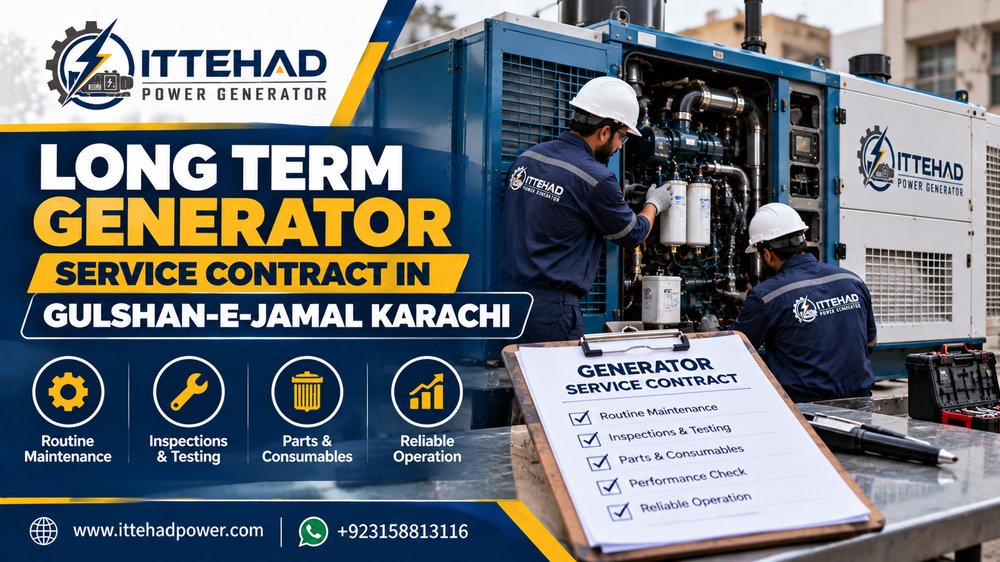
A reliable long term generator service contract in Gulshan-e-Jamal Karachi helps commercial and industrial generator users maintain consistent servicing, timely inspections, documented maintenance, and better operating reliability over an extended period. Instead of arranging maintenance only after a fault occurs, a structured service contract creates a planned approach for routine checks, operating-condition reviews, maintenance scheduling, fault identification, and suitable corrective action. This can help reduce avoidable downtime, improve maintenance control, and provide greater confidence that the generator remains ready for operation when required.
Why a Long Term Generator Service Contract Matters
Generators require attention throughout their operating life. Heat, vibration, operating hours, environmental conditions, component wear, and long standby periods can all affect performance over time.
A long-term service arrangement creates continuity. Previous inspection findings, service dates, repairs, operating hours, and recurring issues can be reviewed during future visits, allowing maintenance decisions to be based on the generator’s actual history rather than isolated observations.
Long Term Generator Service Contract in Gulshan-e-Jamal Karachi
A properly structured long term generator service contract in Gulshan-e-Jamal Karachi should match the generator’s operating pattern, condition, usage, and maintenance requirements. The objective is not simply to schedule repeated visits, but to create a practical maintenance program that supports dependable operation over time.
Commercial and industrial generator users benefit when inspections, service intervals, observations, and required corrective actions are handled consistently under one planned arrangement.
What a Generator Service Contract Should Cover
The exact scope may vary depending on generator condition and operating requirements, but a useful long-term maintenance arrangement should clearly define the main areas that will be inspected and managed.
- Routine generator inspection
- Engine operating-condition checks
- Fuel-system inspection
- Cooling-system checks
- Lubrication-system review
- Battery and starting-system inspection
- Belts and hoses inspection
- Electrical connection checks
- Control-panel observations
- Voltage and frequency checks where applicable
- Operating-hour recording
- Maintenance-history updates
- Fault identification
- Recommendations for required corrective work
Routine Generator Inspections
Regular inspections allow developing issues to be identified before they become more serious. The generator should be reviewed for visible leakage, loose connections, worn components, abnormal noise, unusual vibration, temperature changes, and warning indications.
Consistent inspection is especially useful because technicians can compare the generator’s current condition with previous visits and identify changes that may otherwise go unnoticed.
Planned Service Intervals
A long-term service contract should establish suitable maintenance intervals based on generator usage and operating conditions. A generator with frequent runtime may need attention sooner than a standby unit with limited operating hours.
Service planning should therefore consider both calendar time and accumulated operating hours rather than relying on one factor alone.
Monitoring Generator Operating Hours
Operating-hour records are important for long-term maintenance planning. They help determine when oil changes, filter replacements, inspections, and other scheduled service activities may be due.
Recording operating hours at each visit also helps show how generator usage changes over time and whether maintenance frequency should be adjusted accordingly.
Engine and Lubrication Checks
The engine should be inspected as part of every planned maintenance program. Oil level, oil condition, visible leakage, unusual engine sound, and service history provide useful information about operating condition.
Where oil or filter replacement is required, the service date and operating hours should be recorded for future reference.
Fuel-System Inspection
Reliable fuel delivery is essential for consistent generator starting and operation. A service contract should include routine checks of visible fuel lines, filters, connections, leakage, and signs of contamination where applicable.
Developing fuel restrictions or leakage can often be addressed more effectively when identified during scheduled maintenance rather than after the generator begins losing power or shutting down.
Cooling-System Maintenance
The cooling system should receive regular attention because poor cooling performance can result in overheating and reduced operating reliability. Coolant level, hoses, radiator condition, fan operation, belts, and visible leakage should be inspected according to generator requirements.
Temperature behavior during generator operation can also provide useful information about whether the cooling system is working effectively.
Battery and Starting-System Checks
A generator that cannot start reliably cannot perform its intended function. Battery condition, terminal security, cable condition, charging status, and cranking performance should therefore be included in routine servicing.
Long-term maintenance is particularly useful for standby generators because batteries and starting components can deteriorate even when the generator is not operating frequently.
Electrical and Control-System Inspection
Electrical connections, breaker condition, control-panel indications, voltage, and frequency should be reviewed where appropriate. Loose connections, warning indications, and abnormal readings may provide early evidence of a developing electrical problem.
Any fault identified during a scheduled visit should be documented clearly so that corrective action can be planned before reliability is affected further.
Benefits of a Long Term Generator Service Contract
A planned service arrangement can provide several practical advantages for commercial and industrial generator users.
- Consistent maintenance: Servicing is planned instead of depending on emergency repair requirements.
- Better operating reliability: Developing faults can be identified during routine inspections.
- Reduced unexpected downtime: Worn or deteriorating components may be addressed before complete failure.
- Improved maintenance records: Service dates, operating hours, repairs, and recommendations remain documented.
- Better cost planning: Routine maintenance can be scheduled more predictably.
- Improved fault tracking: Recurring problems become easier to identify over multiple service visits.
- Greater operating confidence: Generator condition is reviewed regularly rather than only after a breakdown.
Preventive Maintenance Versus Emergency Repair
Emergency repairs are sometimes unavoidable, but relying only on reactive maintenance can increase downtime and make costs less predictable. Preventive maintenance focuses on identifying developing conditions before they cause complete failure.
A long-term contract provides a structured opportunity to inspect, test, record, and address generator condition at planned intervals.
Customer Needs in a Long-Term Service Arrangement
Commercial and industrial generator users generally need reliable scheduling, clear maintenance records, practical communication, and transparent recommendations. They also need confidence that maintenance visits are based on a consistent checklist rather than informal inspection.
A suitable contract should make it clear what will be inspected, how often service is planned, how findings will be reported, and how additional corrective work will be handled if a fault is discovered.
How to Select the Right Generator Service Contract
Before agreeing to a long-term generator maintenance arrangement, review both the service scope and the way maintenance will be documented.
- Confirm which generator systems are included in routine inspections.
- Check how service frequency will be determined.
- Ask whether operating hours will be recorded.
- Confirm how consumable replacement will be documented.
- Ask whether generator testing is included where applicable.
- Confirm how faults and repair recommendations will be reported.
- Review whether previous maintenance history will be maintained.
- Clarify how additional repair work will be handled.
- Ensure the service scope matches the generator’s actual operating requirements.
Importance of a Clear Service Scope
A long-term contract should clearly distinguish between routine inspection, scheduled maintenance, consumables, repairs, replacement parts, and additional corrective work. Clear scope helps prevent confusion and allows generator users to understand what is included in the ongoing arrangement.
Transparent service terms also make maintenance costs and responsibilities easier to manage over the contract period.
Maintenance Records and Service History
One of the strongest advantages of a long-term service arrangement is the creation of a continuous maintenance history. Each visit should add useful information about generator condition and completed work.
Useful Maintenance Records Include
- Service date
- Generator operating hours
- Inspection findings
- Oil and filter replacement
- Other consumables replaced
- Faults identified
- Repairs completed
- Parts replaced
- Operating observations
- Recommended future work
Identifying Recurring Generator Problems
A single generator fault may appear isolated, but a long-term maintenance record can reveal whether the same issue is recurring. Repeated coolant loss, battery weakness, starting difficulty, unstable voltage, leakage, or overheating can become easier to recognize when previous service findings are available.
This historical information supports better troubleshooting and can help prevent repeated temporary repairs that do not address the underlying cause.
Safe Generator Inspection
Generator servicing involves mechanical movement, hot components, fuel, batteries, and electrical energy. Inspection and repair work should therefore be carried out using appropriate safety procedures.
Technicians should avoid unnecessary contact with moving or energized components and should follow suitable shutdown and isolation procedures when detailed inspection or repair is required.
Operational Testing During Scheduled Visits
A generator may appear satisfactory while switched off but show problems only when operating. Scheduled service should therefore include an operational check where suitable.
The generator can be observed for starting quality, engine sound, vibration, operating temperature, voltage, frequency, warning indications, and overall stability.
Corrective Action After Inspection
A maintenance contract should not result in automatic replacement of parts whenever a problem is noticed. The cause should be identified first, and corrective work should be based on inspection findings.
Customers should receive clear information about whether the issue requires adjustment, cleaning, repair, replacement, closer monitoring, or no immediate action.
Benefits of Early Fault Identification
Finding a problem during planned maintenance can allow repair to be scheduled before the generator becomes unavailable.
- Worn belts can be identified before breaking
- Loose electrical connections can be corrected before overheating
- Leaks can be addressed before fluid levels become critical
- Weak batteries can be identified before starting failure
- Cooling issues can be investigated before severe overheating
- Filter restrictions can be addressed before power loss
Long-Term Maintenance and Cost Control
A service contract can help make maintenance expenditure more predictable by encouraging scheduled inspection and planned replacement instead of relying entirely on urgent repairs.
Accurate records can also reduce unnecessary replacement because the service team can see when consumables and components were last changed.
Avoiding Unnecessary Parts Replacement
A professional maintenance program should distinguish between normal wear, developing faults, and components that genuinely require replacement. Replacing parts without diagnosis can increase maintenance costs without improving reliability.
Long-term service history helps technicians make better decisions because they can compare current findings with earlier inspections and repairs.
Service Planning for Standby Generators
Standby generators may accumulate relatively few operating hours, but they still require regular attention. Batteries can weaken, fuel condition can change, seals can deteriorate, electrical connections can loosen, and minor leaks can develop during long periods of inactivity.
Periodic inspection and operational testing help confirm that the generator remains ready when required.
Service Planning for Frequently Used Generators
Generators with higher operating hours can require more frequent maintenance. Oil, filters, belts, hoses, cooling components, and other service items may reach their maintenance intervals sooner.
A long-term service plan should be flexible enough to reflect actual generator usage rather than relying only on fixed calendar dates.
Local Relevance in Gulshan-e-Jamal Karachi
Generator users in Gulshan-e-Jamal Karachi can have different maintenance requirements depending on operating environment, generator usage, ventilation, dust exposure, running duration, and load conditions. A service plan should take the actual installation and operating pattern into account.
Local servicing can also support easier scheduling, regular inspection coordination, and quicker communication when a developing generator problem is identified during the contract period.
Why Site Conditions Should Be Considered
Environmental conditions can influence generator maintenance needs. Heat, dust, ventilation, access, and operating duration may affect cooling-system condition, filter service intervals, battery performance, and general component wear.
A maintenance contract should therefore be based on the actual generator environment instead of using the same schedule for every installation.
Trust Points When Choosing a Generator Service Provider
A long-term generator service relationship should be built around consistent inspection, clear reporting, and practical maintenance decisions.
- Structured maintenance checklist
- Clear service schedule
- Operating-hour tracking
- Documented inspection findings
- Transparent repair recommendations
- Fault diagnosis before parts replacement
- Clear maintenance history
- Operational testing after service where required
- Practical guidance for future maintenance
Common Mistakes When Choosing a Service Contract
The value of a long-term agreement depends on the quality and clarity of the maintenance program. Generator users should avoid contracts that provide little detail about actual servicing.
- Selecting a contract based only on the lowest price
- Not confirming what maintenance is included
- Ignoring operating-hour-based service requirements
- Accepting maintenance without written records
- Not documenting consumable replacement
- Allowing faults to remain unresolved between visits
- Replacing parts without proper diagnosis
- Skipping operational testing
- Using the same maintenance frequency regardless of generator usage
Guidance Before Starting a Long-Term Generator Contract
Before the contract begins, establish the current generator condition. Record operating hours, recent service history, existing faults, fluid condition, filter history, battery condition, cooling-system observations, and any previous repairs that may be relevant.
This initial assessment provides a useful baseline for future inspections and helps distinguish existing issues from new conditions that develop during the contract period.
Review Service Performance Over Time
A long-term contract should be reviewed periodically to confirm that the maintenance schedule still matches generator usage. If operating hours increase significantly or site conditions change, service frequency may also need adjustment.
Reviewing maintenance history can also show whether recurring problems require more detailed investigation.
Maintain Better Generator Reliability in Gulshan-e-Jamal Karachi
A structured long term generator service contract in Gulshan-e-Jamal Karachi can provide commercial and industrial generator users with consistent inspections, planned servicing, better maintenance records, earlier fault identification, and more predictable maintenance management. The most effective arrangements are based on actual generator condition, operating hours, site requirements, and documented service history.
If your generator maintenance is currently arranged only when a problem occurs, consider moving to a planned long-term service arrangement. Regular inspections, accurate records, safe fault diagnosis, timely corrective action, and consistent operational checks can help improve generator reliability and provide greater confidence throughout its operating life.