
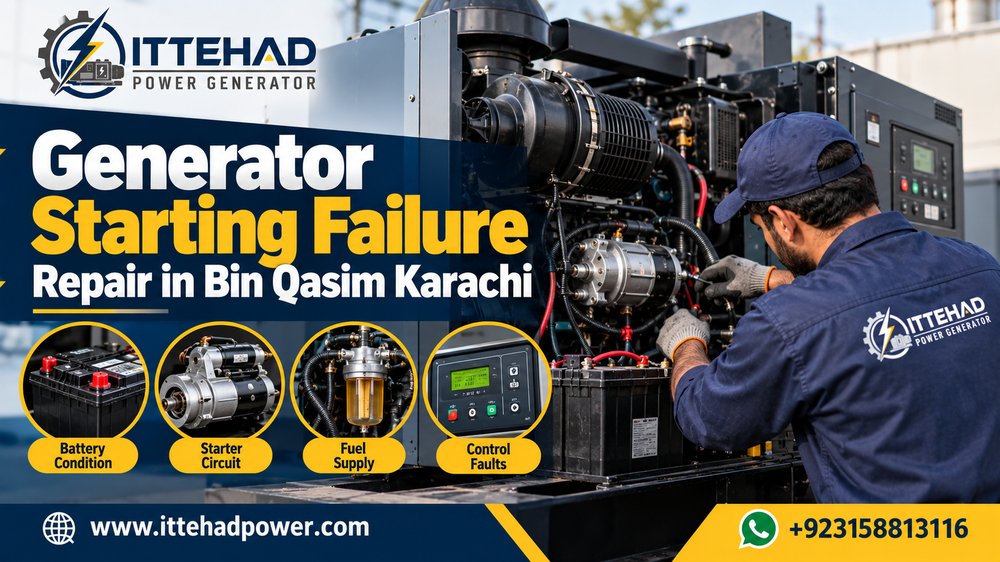
A generator that refuses to start can interrupt essential power availability and create unnecessary downtime. Professional generator starting failure repair in Bin Qasim Karachi begins with systematic diagnosis of the battery, starter circuit, fuel supply, control system, wiring, and engine starting conditions. Instead of replacing parts by guesswork, a careful inspection helps identify the real cause of the no-start condition and supports a reliable, practical repair.
Why Generator Starting Failure Needs Immediate Attention
A generator is expected to start when power is required. If the engine does not crank, cranks slowly, turns normally but fails to fire, or starts only after repeated attempts, the problem should be investigated before the starting system becomes completely unreliable.
Starting problems can develop gradually. Weak batteries, deteriorated connections, restricted fuel delivery, starter faults, or control issues may initially cause occasional hesitation before progressing to complete starting failure.
Generator Starting Failure Repair in Bin Qasim Karachi
Effective generator starting failure repair in Bin Qasim Karachi requires checking the complete starting sequence rather than focusing on only one component. A generator relies on several systems working together before the engine can start and stabilize.
A proper diagnosis should establish whether the fault is related to electrical cranking power, the starter circuit, fuel availability, control signals, engine condition, or another part of the starting process.
Common Generator Starting Failure Symptoms
The way a generator behaves during a failed start provides useful information about the possible cause. Different symptoms often point toward different systems that require inspection.
- No response when the start command is given
- Starter clicks but the engine does not crank
- Engine cranks slowly
- Engine cranks normally but does not start
- Generator starts and immediately stops
- Several attempts are required before starting
- Starting performance becomes inconsistent
- Control panel shows a starting-related warning or fault
- Starter motor operates intermittently
- Engine struggles to remain running after initial ignition
These symptoms should be assessed together with battery condition, fuel supply, wiring, and generator history.
Battery Condition and Starting Performance
The battery is one of the first components to check when a generator does not start. A weak or discharged battery may still power indicators or the control panel while failing to provide enough current to operate the starter motor correctly.
Battery-related starting problems can be associated with:
- Low battery charge
- Aged or deteriorated battery condition
- Loose battery terminals
- Corroded connections
- Damaged battery cables
- Poor grounding connections
- Charging problems
Battery voltage alone may not always confirm its ability to perform under starting load. The complete battery and cable condition should be considered during diagnosis.
Signs of a Weak Starting Battery
A weak battery can cause slow cranking, repeated clicking, dim control indications during cranking, or complete failure of the starter to turn the engine. If starting performance improves temporarily after charging but the problem returns, further battery and charging-system checks may be required.
Starter Motor and Starter Circuit Problems
If sufficient battery power is available but the engine does not crank correctly, the starter circuit should be inspected. The starting circuit includes the starter motor and the electrical path that allows current and control signals to reach it.
Possible starting circuit problems include:
- Loose electrical connections
- Damaged wiring
- Poor grounding
- Faulty starter relay
- Starter solenoid problems
- Worn starter motor components
- Intermittent control connections
A starter that clicks without turning the engine may indicate a different fault from a starter that remains completely inactive. Careful testing helps identify where the starting sequence is being interrupted.
Fuel Supply Problems That Prevent Generator Starting
A generator may crank normally but still fail to start if the engine is not receiving the correct fuel supply. Fuel-system checks are especially important when the starter appears to operate normally but combustion does not begin.
Fuel-related starting failure can involve:
- Insufficient fuel supply
- Blocked fuel filters
- Restricted fuel lines
- Air trapped in the fuel system
- Fuel contamination
- Water or sediment in fuel
- Fuel delivery component problems
The presence of fuel in the tank does not automatically confirm that fuel is reaching the engine correctly. The complete delivery path may need inspection.
Air in the Fuel System
Air entering the fuel system can prevent consistent fuel delivery during starting. This may occur after fuel-system work, low fuel conditions, loose connections, or leakage on the supply side.
When air is suspected, the system should be inspected for the source of air entry and properly prepared according to the generator’s fuel-system requirements.
Blocked Fuel Filters and Starting Difficulty
A heavily restricted fuel filter can reduce fuel flow enough to cause extended cranking or complete failure to start. Filters should be inspected when there is evidence of contamination, overdue maintenance, or gradually worsening starting performance.
Replacing a filter should be based on its condition and diagnosis. If contamination is present, the surrounding fuel system may also require inspection so the replacement filter does not become restricted again quickly.
Generator Control System Faults
The generator control system manages important starting commands and protective functions. A control fault, incorrect signal, damaged connection, or active protection condition may prevent the starting sequence from completing.
Control-related diagnosis may involve checking:
- Start command response
- Control panel indications
- Warning or fault messages
- Emergency stop condition
- Relevant sensors and switches
- Control wiring and connectors
- Starter relay command
Resetting a fault without identifying why it occurred may only provide temporary relief. Repeated control warnings should be investigated properly.
Emergency Stop and Safety Interlock Checks
A generator may appear to have a serious starting problem when a safety circuit is intentionally preventing operation. Emergency stop controls and protective interlocks should therefore be included in the diagnostic process.
If a protection system is active, the reason for activation should be identified before restarting the generator. Safety controls should not be bypassed simply to make the generator run.
Engine Cranks but Does Not Start
When the starter turns the engine at a normal speed but the generator does not start, attention usually shifts toward fuel delivery, control signals, engine starting conditions, and combustion-related factors.
Useful checks may include:
- Confirming adequate fuel availability
- Checking fuel filter condition
- Inspecting for air in fuel lines
- Reviewing control panel warnings
- Checking relevant shutdown signals
- Observing exhaust behavior during cranking
- Assessing whether further engine testing is required
The goal is to determine why the engine is turning but not beginning normal combustion.
Generator Does Not Crank at All
A generator that produces no cranking movement generally requires inspection of the electrical starting system and control command path. Battery condition, cable connections, starter relay operation, starter motor condition, and control signals should be checked systematically.
Changing the starter motor immediately may not solve the issue if the actual cause is a weak battery, poor connection, relay fault, or missing start command.
Slow Cranking During Generator Start
Slow cranking reduces the engine speed available during starting and may prevent successful ignition. This condition is commonly associated with insufficient battery power, high resistance in electrical connections, cable problems, or starter motor condition.
Repeatedly attempting to start a generator that is cranking abnormally slowly can place additional stress on the battery and starting components. The cause should be identified before repeated attempts continue.
Why Systematic Generator Diagnosis Matters
Starting failure can involve several interconnected systems, which makes systematic diagnosis more effective than random component replacement. Testing each stage of the starting process helps narrow the fault and reduces unnecessary repair costs.
A structured approach also helps distinguish between a simple connection problem and a fault requiring component repair or replacement.
Benefits of Proper Starting Failure Diagnosis
- Helps identify the actual cause of the no-start condition
- Reduces unnecessary parts replacement
- Supports faster restoration of generator operation
- Helps prevent repeated starting problems
- Improves reliability of the starting system
- Allows repair decisions to be based on inspection and testing
- Helps reduce avoidable generator downtime
A Practical Generator Starting Failure Inspection Process
A professional inspection should follow the starting sequence logically. The exact procedure depends on the symptoms, but a practical process may include:
- Confirm the complaint: Observe what happens when the generator receives a start command.
- Check the battery: Inspect charge condition, terminals, cables, and connections.
- Inspect the starting circuit: Check relays, wiring, grounding, starter connections, and starter response.
- Review control indications: Look for active warnings, shutdown conditions, or missing start signals.
- Check fuel availability: Confirm that suitable fuel can reach the engine correctly.
- Inspect filters and fuel lines: Look for restrictions, leakage, contamination, or air entry.
- Assess engine cranking behavior: Determine whether cranking speed and sound are normal.
- Investigate deeper causes when necessary: Carry out additional testing if basic electrical and fuel checks do not identify the fault.
- Test after repair: Verify starting performance through controlled restart checks.
What Customers Need From Generator Starting Repair
When a generator fails to start, customers usually need a clear explanation and an efficient route to restoring operation. They need to know whether the problem is minor, whether a component needs replacement, and whether any related systems should also be checked.
Useful service should therefore focus on:
- Accurate diagnosis
- Clear communication about the fault
- Inspection before replacing components
- Correct repair planning
- Testing after corrective work
- Practical recommendations to reduce repeat failures
How to Choose a Generator Starting Failure Repair Service
A suitable repair service should investigate the full starting system rather than immediately recommending expensive components. Good diagnosis begins with the symptoms and follows the electrical, fuel, control, and engine systems as required.
Important selection points include:
- Diagnosis before major parts replacement
- Battery and starting circuit testing
- Fuel-system inspection where relevant
- Control fault checking
- Clear explanation of findings
- Safe repair practices
- Verification that the generator starts correctly after repair
Local Relevance of Generator Starting Repair in Bin Qasim Karachi
Access to generator starting repair support in Bin Qasim Karachi can help reduce delays when a generator unexpectedly fails to operate. Local support can make it easier to arrange diagnosis of batteries, starter systems, fuel delivery, control faults, and related starting problems.
Operating conditions can also influence starting reliability. Heat, dust, long standby periods, battery condition, fuel storage, and maintenance history can affect how consistently a generator starts. Diagnosis should therefore consider both the immediate fault and the conditions in which the generator operates.
Trust Points in Generator Starting Failure Repair
A dependable repair process should be transparent and based on confirmed findings. Customers should understand which system caused the starting failure and why a particular repair or replacement is recommended.
Useful trust points include:
- Systematic fault diagnosis
- No unnecessary component replacement
- Clear explanation of test findings
- Inspection of connected systems where needed
- Correctly matched replacement parts when required
- Attention to electrical and fuel safety
- Post-repair starting checks
Preventing Future Generator Starting Problems
Not every starting failure can be predicted, but regular attention to the starting and fuel systems can help identify developing problems before the generator becomes unavailable.
Practical preventive steps include:
- Check battery condition periodically
- Keep battery terminals clean and secure
- Inspect cables and grounding connections
- Maintain clean fuel and suitable fuel levels
- Inspect fuel filters according to operating conditions
- Watch for fuel leakage or air entry
- Investigate intermittent starter operation early
- Do not ignore recurring control warnings
- Test generator starting performance regularly
Guidance When a Generator Will Not Start
If a generator fails to start, avoid repeated cranking without first checking the basic condition of the starting system. Continuous unsuccessful starting attempts can drain the battery and place additional strain on the starter motor.
Observe whether the engine cranks, whether the starter clicks, whether control warnings appear, and whether there are unusual sounds or smells. These observations can provide useful information for diagnosis.
If damaged cables, fuel leakage, overheating, smoke, or serious electrical problems are present, the generator should be inspected before further starting attempts.
When Professional Repair Is Recommended
Professional diagnosis is recommended when the generator repeatedly fails to start, cranks slowly despite a charged battery, produces only a starter click, cranks normally without firing, starts and immediately stops, or displays recurring control faults.
Testing starter circuits, control systems, fuel delivery, and internal engine conditions may require suitable equipment and experienced troubleshooting. Proper diagnosis can prevent unnecessary replacement work and help restore dependable starting performance.
Arrange Generator Starting Failure Repair in Bin Qasim Karachi
A generator that cannot start cannot provide dependable standby power when it is needed. Professional generator starting failure repair in Bin Qasim Karachi should focus on battery condition, starter circuits, fuel delivery, control faults, wiring, engine behavior, and systematic fault identification.
If your generator is not cranking, turning slowly, failing to fire, starting intermittently, or shutting down immediately after starting, arrange a thorough inspection before the problem becomes more difficult to resolve. Correct diagnosis and targeted repair can help restore reliable starting, reduce unnecessary downtime, and improve confidence in generator operation.