
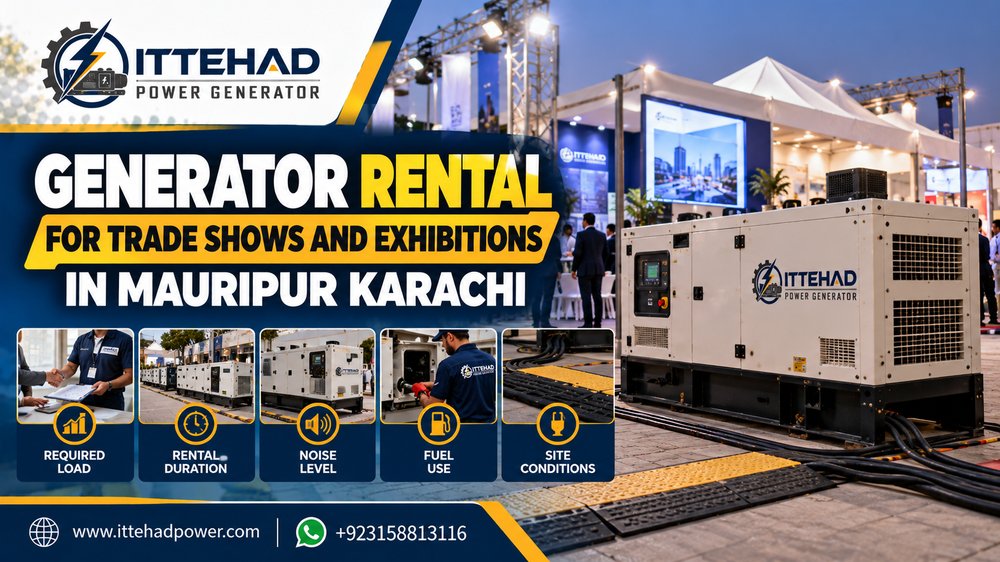
Reliable generator rental for trade shows and exhibitions in Mauripur Karachi helps organizers, exhibitors, and commercial users maintain dependable temporary power for lighting, display equipment, registration systems, audio-visual requirements, cooling, and other event-related electrical loads. Selecting the right rental generator requires more than choosing a capacity from a list. Required load, starting demand, rental duration, noise level, fuel use, site access, cabling, ventilation, positioning, and backup-power reliability should all be considered before the event begins. Careful planning can reduce power interruptions, avoid unnecessary rental costs, and provide greater operating confidence throughout the exhibition period.
Why Reliable Generator Power Matters for Trade Shows and Exhibitions
Trade shows and exhibitions often depend on electricity for displays, lighting, digital screens, registration systems, sound equipment, cooling, and other essential event functions. A power interruption can affect multiple areas at the same time and create unnecessary disruption for exhibitors and visitors.
A suitable rental generator provides an independent power source that can be planned according to the actual electrical requirement. The goal is to provide stable temporary power without overloading the generator or paying for excessive unused capacity.
Generator Rental for Trade Shows and Exhibitions in Mauripur Karachi
Professional generator rental for trade shows and exhibitions in Mauripur Karachi should begin with a practical review of the event’s electrical load, operating hours, venue conditions, cable distances, noise requirements, and expected backup needs. Every exhibition setup can have a different electrical profile depending on the number of stalls, lighting arrangements, display systems, cooling requirements, and equipment operating at the same time.
A site-specific rental plan helps ensure that generator size, cable layout, fuel planning, and operating arrangements match the actual event rather than relying on rough estimates.
Start With an Accurate Load Assessment
Load calculation is one of the most important parts of generator rental planning. The generator should be selected according to the electrical equipment that needs power and the maximum demand expected during the event.
Organizers should prepare a list of electrical loads and identify which equipment may operate simultaneously.
Typical Exhibition Electrical Loads May Include
- Booth and display lighting
- Digital screens and monitors
- Registration equipment
- Audio and presentation systems
- Display electronics
- Cooling and ventilation equipment
- Computers and communication devices
- General event lighting
- Temporary electrical outlets
- Other exhibition-related electrical equipment
Consider Starting Load as Well as Running Load
Some electrical equipment requires a higher amount of power during startup than during normal operation. Cooling equipment, motors, and certain electrical systems may create temporary demand that is significantly higher than their running load.
The rental generator should have enough capacity to handle these starting requirements without excessive voltage drop or unstable frequency.
Avoid Renting a Generator That Is Too Small
An undersized rental generator may operate normally at light demand but struggle when additional exhibition loads are connected. Voltage can drop, frequency may change, breakers may trip, and the generator may overheat or shut down.
Capacity should therefore include a practical operating margin above the expected normal load.
Avoid Unnecessary Oversizing
Choosing a much larger generator than required can increase rental and fuel costs without providing a meaningful benefit. The best approach is to select enough capacity for expected running and starting loads while avoiding excessive unused output.
Accurate load information allows a more suitable rental recommendation.
Plan the Rental Duration Carefully
Trade shows and exhibitions often require power before visitors arrive and after the public event period ends. Setup, testing, exhibitor preparation, event operating hours, and dismantling may all affect the total rental duration.
Rental Duration Planning Should Consider
- Generator delivery time
- Installation and cable setup
- Pre-event testing
- Exhibitor setup period
- Public exhibition hours
- Daily operating schedule
- Post-event shutdown
- Removal and collection timing
Allowing enough time for testing before the event begins can help identify power or connection problems without disrupting exhibition activity.
Noise Level for Exhibition Generator Rental
Noise is an important consideration where exhibitors, visitors, presentations, or conversations are taking place nearby. Generator positioning and equipment configuration should therefore be planned with sound impact in mind.
Noise level can be influenced by generator design, enclosure, electrical load, exhaust system, surrounding structures, and distance from activity areas.
Choose the Generator Position Carefully
The generator should be positioned where it can operate safely without creating unnecessary disturbance or restricting visitor and exhibitor movement. The location should also provide sufficient space for cooling airflow, exhaust discharge, cables, refueling, inspection, and maintenance.
Generator Placement Considerations
- Distance from exhibition activity
- Access for delivery and removal
- Stable ground or surface
- Ventilation
- Exhaust direction
- Cable distance to the load
- Refueling access
- Noise impact
- Maintenance access
- Protection from accidental contact
Ventilation and Cooling Requirements
A rental generator produces substantial heat during operation and needs sufficient fresh air for engine combustion and cooling. Restricted airflow can increase operating temperature and reduce reliability during long exhibition hours.
The generator should not be positioned where radiator hot air is trapped or repeatedly drawn back into the cooling system.
Exhaust Routing and Safe Positioning
Generator exhaust should be directed away from occupied areas, entrances, ventilation openings, and places where fumes could accumulate. The exhaust path should remain clear throughout the event.
Positioning should be reviewed before installation so exhaust and hot-air discharge do not interfere with the exhibition environment.
Plan Electrical Cabling Before the Event
Cable planning is a major part of exhibition generator rental. Power may need to travel from the generator to distribution points and then to individual exhibition areas.
Cables should be correctly sized for expected current and protected from physical damage, excessive heat, moisture, and foot or equipment traffic.
Cable Planning Should Consider
- Required cable length
- Expected current
- Voltage requirement
- Connection points
- Distribution layout
- Route through the exhibition area
- Protection from traffic
- Voltage drop over distance
Long Cable Runs and Voltage Drop
Long cable runs can reduce voltage at the point of use, especially if cable size is not suitable for current and distance. The generator may produce correct voltage while equipment farther away receives less.
Where long cable distances are unavoidable, conductor size and distribution layout should be planned accordingly.
Electrical Distribution Across Exhibition Areas
Large trade shows may require power at several different locations. A planned distribution arrangement helps prevent too many loads from being connected to one circuit or one area of the electrical system.
Load distribution should be reviewed before the event and monitored if exhibitors add equipment later.
Check Voltage and Phase Requirements
The rental generator should match the electrical configuration required by the exhibition equipment. Voltage, frequency, and phase arrangement should be confirmed before delivery.
Incorrect electrical configuration can delay setup and create unnecessary changes immediately before the event.
Balance Generator Loads Where Applicable
Where a multi-phase generator is used, exhibition loads should be distributed appropriately between phases. Significant imbalance can result in uneven voltage and additional alternator heating.
Individual phase current should be reviewed during setup where applicable.
Fuel Planning for the Complete Exhibition Period
Fuel requirements depend on generator size, operating load, runtime, and engine efficiency. An exhibition generator that operates for long hours needs a clear refueling plan.
Fuel Planning Questions
- How many hours per day will the generator operate?
- What is the expected average load?
- What fuel tank capacity is available?
- Who will monitor fuel level?
- When can refueling be completed without disrupting the event?
- Is additional fuel required for backup operating time?
Do Not Wait Until Fuel Is Almost Finished
Running a generator too close to an empty fuel level can create unnecessary operational risk. Fuel should be monitored throughout the event and replenished according to a planned schedule.
Refueling arrangements should also allow enough time for delays or unexpected increases in generator operating hours.
Pre-Event Generator Inspection
The rental generator should be checked before delivery or before it is placed into normal exhibition operation. A basic condition inspection can reduce the chance of avoidable faults during the event.
Pre-Event Checks May Include
- Engine oil level and condition
- Coolant level
- Fuel-system condition
- Battery condition
- Air filter condition
- Belts and hoses
- Visible leakage
- Control-panel operation
- Voltage output
- Frequency
- General mechanical condition
Test the Generator After Installation
Once the generator has been positioned and connected, it should be tested before the exhibition begins. Starting performance, voltage, frequency, temperature, sound, vibration, and electrical connections should be observed.
Testing early provides time to correct issues before exhibitors and visitors depend on the power supply.
Load Testing Before the Exhibition Starts
A generator may operate normally with no electrical load but behave differently when exhibition equipment is connected. Controlled load testing can confirm that the generator can handle the expected demand.
Voltage, frequency, temperature, and engine response should remain stable as the load increases.
Backup-Power Reliability
If the generator is intended to support essential exhibition activity, reliability should be considered alongside rental cost. Equipment condition, fuel planning, load capacity, cable connections, and availability of support all contribute to dependable temporary power.
Where uninterrupted operation is especially important, the backup strategy should be discussed before the event rather than after a power problem occurs.
Consider Changes in Exhibition Load During the Day
Electrical demand may not remain constant throughout an exhibition. Screens, cooling equipment, lighting, and presentation systems may switch on and off at different times.
The rental generator should be able to handle expected load variation without excessive voltage or frequency changes.
Sensitive Exhibition Equipment
Digital displays, computers, presentation systems, and other electronic equipment can be more sensitive to unstable electrical supply than simple lighting loads.
Generator voltage and frequency should therefore remain within suitable operating limits, particularly where sensitive electronics form an important part of the exhibition.
Protect Equipment From Unstable Generator Output
Good protection begins with correct generator sizing, proper cabling, secure electrical connections, and stable voltage and frequency.
- Avoid generator overloading
- Use suitable cable sizes
- Check electrical connections
- Monitor voltage
- Monitor frequency
- Balance loads where applicable
- Investigate repeated voltage fluctuations
- Test major equipment before the event begins
Benefits of Professional Exhibition Generator Rental
A properly planned rental arrangement can provide several advantages for event organizers and exhibitors.
- Reliable temporary power: Generator capacity is matched to expected electrical demand.
- Reduced overload risk: Running and starting loads are considered before selection.
- Better cost control: Excessive generator capacity and unnecessary fuel use can be avoided.
- Improved event continuity: Power arrangements are tested before the exhibition begins.
- Better noise management: Generator positioning considers the exhibition environment.
- Safer cabling: Cable routes and distribution can be planned before visitors arrive.
- Greater operating confidence: Fuel, load, and support requirements are considered in advance.
What Trade Show and Exhibition Organizers Need
Event organizers need more than a generator delivered to site. They need reliable capacity planning, practical positioning, suitable cabling, stable electrical output, fuel arrangements, and a clear operating plan.
The rental provider should understand how long the generator will run, what equipment it will power, and whether electrical demand may change during the event.
How to Select the Right Rental Generator
Generator selection should be based on actual event requirements rather than a rough estimate.
- Prepare a list of all electrical loads.
- Identify equipment with high starting demand.
- Estimate the maximum simultaneous load.
- Confirm voltage and phase requirements.
- Determine daily operating hours.
- Review noise restrictions or preferences.
- Measure approximate cable distances.
- Check delivery and placement access.
- Plan fuel for the complete event period.
- Allow time for testing before opening.
How to Select a Generator Rental Provider
A suitable rental provider should ask detailed questions about the exhibition rather than recommending equipment based only on a requested capacity.
Useful Selection Points
- Load assessment support
- Clear generator capacity information
- Electrical configuration confirmation
- Suitable cable planning
- Generator condition inspection
- Fuel arrangement guidance
- Setup and testing support
- Clear rental duration terms
- Support if an operating issue develops
Avoid Choosing Generator Rental Only by Price
A low rental rate may not provide good value if important requirements such as cables, suitable capacity, delivery, setup, testing, or operational support are missing.
The complete rental arrangement should be compared rather than looking only at the base generator price.
Review What Is Included in the Rental
Before confirming the booking, organizers should understand exactly what is included and what must be arranged separately.
- Generator unit
- Required cables
- Delivery
- Positioning
- Installation support
- Fuel
- Operating supervision where required
- Maintenance during longer rentals
- Collection after the event
Plan Generator Delivery Before Exhibition Setup Is Complete
The generator should be delivered early enough to allow positioning, cabling, testing, and any required adjustments before the final exhibition setup is finished.
Late delivery can make cable routing and equipment access more difficult once stalls, displays, and visitor areas are already arranged.
Access for Delivery and Removal
Generator size affects transportation and positioning requirements. The route to the installation point should be checked for width, turning space, surface condition, and any access restrictions.
Removal should also be considered because the site may look very different after exhibition equipment and visitors are present.
Site Conditions in Mauripur Karachi
Trade shows and exhibitions in Mauripur Karachi may involve different site conditions depending on available space, cable distance, generator placement, surrounding activity, ventilation, and operating hours. These factors should be reviewed before the generator is selected and delivered.
A local site assessment can help determine a practical location for the generator, safe cable routes, suitable ventilation, and access for refueling and maintenance.
Heat and Generator Rental Planning
High surrounding temperature can increase generator cooling requirements during long event hours. Radiator airflow and ventilation should remain clear, particularly when the generator carries substantial load.
Temperature should be monitored if the generator operates continuously or close to its planned capacity.
Dust and Exhibition Generator Operation
Dust can affect air filters and cooling surfaces. A generator operating in dusty conditions may require more frequent inspection to maintain suitable airflow and temperature.
Placement should avoid unnecessary exposure to heavy dust where practical.
Restricted Space at Exhibition Sites
Limited space can make generator placement difficult, but ventilation, exhaust discharge, cable routing, and service access should not be ignored.
The generator should not be placed in a position that creates heat buildup or makes refueling and inspection impractical.
Noise Planning for Visitor Areas
Where presentations, conversations, or exhibitor meetings are important, generator noise should be considered before final positioning.
Increasing distance from visitor activity and selecting a suitable generator configuration can help reduce unnecessary disturbance while maintaining practical cable lengths.
Monitor Generator Operation During the Exhibition
Generator performance should be observed throughout the rental period, especially during peak electrical demand.
Operating Conditions to Monitor
- Fuel level
- Engine temperature
- Oil-pressure indications
- Voltage
- Frequency
- Electrical load
- Control-panel warnings
- Visible leaks
- Unusual noise
- Excessive vibration
Do Not Add Major Loads Without Reviewing Capacity
Exhibitors may add displays, lighting, screens, or other electrical equipment after the original load calculation has been completed. Significant additions should be reviewed before connection.
Unexpected load growth can turn a properly sized generator into an overloaded one.
Record Generator Operating Hours
For longer exhibitions, operating-hour records can help with fuel and maintenance planning. They also provide useful information if the rental period is extended.
If the generator reaches a service interval during a long rental, maintenance should be planned rather than delayed simply because the event is still in progress.
Common Exhibition Generator Rental Mistakes
- Guessing the required generator capacity
- Ignoring starting loads
- Booking only according to lowest rental price
- Failing to confirm cable requirements
- Ignoring voltage drop over long cable runs
- Not planning fuel for the full event
- Placing the generator in a poorly ventilated area
- Ignoring noise impact
- Adding new loads without reviewing capacity
- Skipping pre-event generator testing
Trust Points for Trade Show Generator Rental
A professional generator rental arrangement should provide clear planning from load assessment through final testing.
- Generator capacity based on actual electrical demand
- Starting loads considered
- Voltage and phase requirements confirmed
- Site access reviewed
- Noise and ventilation considered
- Cable routes planned
- Fuel requirements discussed
- Generator inspected before use
- Testing completed after setup
- Practical support available during the rental period
Guidance Before Requesting an Exhibition Generator Quote
Providing complete event information can make rental recommendations more accurate.
Information to Prepare
- Event dates
- Daily operating hours
- List of electrical equipment
- Estimated running load
- Starting load requirements
- Voltage and phase requirement
- Approximate cable distance
- Available generator location
- Noise considerations
- Fuel and refueling requirements
Pre-Opening Power Check
Before the exhibition opens, all important electrical loads should be tested through the intended generator distribution arrangement. This can identify overload, voltage drop, loose connections, or cable issues before visitor activity begins.
Testing should also confirm that the generator can recover normally when major loads start and stop.
During-Event Power Management
Once the exhibition is active, unnecessary changes to electrical distribution should be avoided. New connections should be made carefully, and generator load should remain within suitable operating limits.
Any voltage warning, frequency change, overheating, or repeated breaker trip should be investigated promptly.
Post-Event Generator Shutdown
At the end of the exhibition, electrical loads should be disconnected in a controlled manner and the generator should be shut down according to proper operating procedures.
Cables and distribution equipment should then be removed safely before the generator is prepared for collection.
Benefits of Planning Rental Power Early
Early generator planning gives organizers time to calculate load, compare equipment options, arrange a suitable generator position, plan cable routes, and schedule testing without unnecessary pressure.
It can also reduce the chance of paying for last-minute capacity changes or additional equipment that could have been identified earlier.
Maintain Reliable Exhibition Power in Mauripur Karachi
Professional generator rental for trade shows and exhibitions in Mauripur Karachi should combine accurate load assessment, suitable generator capacity, planned rental duration, noise consideration, fuel management, safe cabling, appropriate site positioning, and pre-event testing. A complete rental plan helps organizers and exhibitors maintain reliable temporary power while controlling operating costs and reducing the risk of electrical disruption.
If you are arranging a trade show or exhibition in Mauripur Karachi, prepare your expected electrical loads, operating schedule, cable distance, site conditions, noise requirements, and fuel needs before confirming the generator rental. A properly sized, inspected, installed, and tested generator can provide more dependable exhibition power and greater operating confidence throughout the event.