
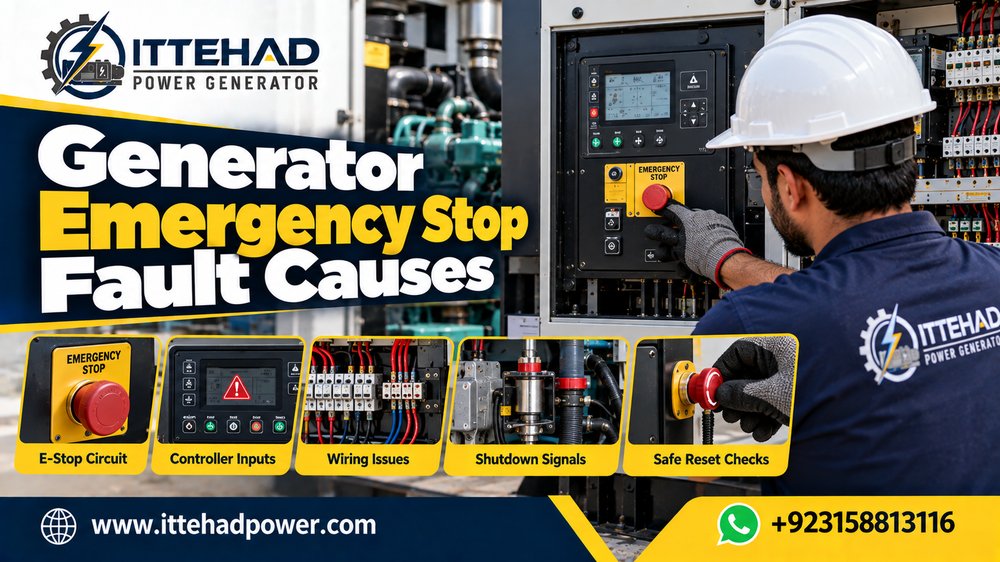
Understanding generator emergency stop fault causes is important when a generator refuses to start, shuts down unexpectedly, or continues showing an emergency stop warning even after the E-stop button appears to be released. The fault can involve the emergency stop switch itself, wiring, controller inputs, shutdown circuits, loose connections, damaged contacts, control logic, or another protective signal. Because the emergency stop system is a safety function, troubleshooting should focus on identifying the actual cause rather than bypassing protection or repeatedly resetting the controller without inspection.
Why an Emergency Stop Fault Needs Careful Diagnosis
The emergency stop circuit is designed to stop generator operation quickly when a potentially unsafe condition requires immediate shutdown. When the controller detects an active emergency stop signal, it may prevent starting or shut the generator down immediately.
A persistent E-stop warning does not always mean that the emergency stop button has been physically pressed. Wiring faults, damaged contacts, loose terminals, controller input problems, or related shutdown signals can create the same indication.
Correct diagnosis helps restore generator availability while keeping the intended safety protection functional.
Generator Emergency Stop Fault Causes and Common Warning Signs
Common generator emergency stop fault causes can involve mechanical, electrical, wiring, and controller-related conditions. The exact troubleshooting process depends on how the fault appears and whether it is constant or intermittent.
Typical symptoms include:
- Generator will not start
- Controller displays emergency stop alarm
- Generator shuts down immediately after starting
- Emergency stop warning remains after reset
- Fault returns when vibration occurs
- Generator starts intermittently
- Controller shows shutdown input active
- E-stop button appears released but alarm remains
These symptoms should lead to inspection of the complete emergency stop circuit rather than immediate controller replacement.
How the Emergency Stop Circuit Works
The emergency stop switch forms part of the generator shutdown and safety circuit. Depending on the generator control design, pressing the button changes the electrical state of the circuit and tells the controller to stop or inhibit operation.
The circuit may involve:
- Emergency stop push button
- Switch contacts
- Control wiring
- Terminal blocks
- Controller input
- Relays where fitted
- Remote emergency stop devices where installed
- Shutdown logic
A fault anywhere in this path can potentially create an emergency stop indication.
Emergency Stop Button Still Engaged
The simplest cause is that the emergency stop button remains mechanically latched. Some E-stop switches need to be twisted, pulled, or otherwise released before the circuit returns to its normal state.
Before deeper troubleshooting, check:
- Button position
- Release mechanism
- Mechanical movement
- Signs of physical damage
- Whether the button returns fully to its normal position
A partially released or damaged mechanism may continue holding the shutdown circuit active.
Damaged Emergency Stop Switch
The switch itself can wear, break internally, become contaminated, or develop damaged contacts. A button may appear normal externally while its electrical contacts remain open or unstable.
Possible signs include:
- Fault remains after mechanical release
- Alarm appears when the button is moved slightly
- Intermittent operation
- Visible physical damage
- Loose switch body
- Inconsistent continuity during testing
Electrical testing should confirm switch condition before replacement is recommended.
Loose Wiring in the E-Stop Circuit
Loose terminals are a common cause of intermittent generator control faults. Vibration, previous maintenance, poor terminal tightening, or wire movement can interrupt the emergency stop circuit.
Inspect:
- E-stop switch terminals
- Controller input terminals
- Intermediate terminal blocks
- Relay connections where applicable
- Wire joints
- Connector plugs
A connection that appears secure visually may still require proper electrical inspection.
Broken or Damaged Control Wiring
Emergency stop wiring can become damaged by heat, vibration, abrasion, moisture, sharp edges, or previous repair work.
Damaged wiring may cause:
- Permanent shutdown indication
- Intermittent E-stop alarms
- Faults that appear only when the generator vibrates
- Controller input changing unexpectedly
The full wiring path should be inspected where practical, especially when the fault returns after the generator starts or after equipment movement.
Corroded Electrical Connections
Corrosion can increase resistance or interrupt low-voltage control signals. Generator control circuits can be sensitive to poor connections even when the affected terminal still appears physically connected.
Check for:
- Green or white corrosion deposits
- Darkened terminals
- Moisture
- Loose connector pins
- Damaged terminal surfaces
Corroded connections should be cleaned, repaired, or replaced as appropriate rather than repeatedly resetting the controller.
Controller Emergency Stop Input Fault
The generator controller monitors the emergency stop circuit through a dedicated input or shutdown logic. If the input remains active despite the physical switch and wiring being correct, the controller input or associated control circuitry may require further testing.
Useful checks can include:
- Controller input status
- Input wiring
- Terminal voltage where appropriate
- Controller configuration
- Related relay operation
- Recent controller or wiring work
Controller replacement should generally be considered only after external wiring and switch conditions have been checked.
Incorrect Controller Configuration
If controller settings have recently been changed, an incorrect input configuration can create unexpected emergency stop behavior. A digital input may be assigned incorrectly or configured with the wrong active state.
This possibility becomes more relevant after:
- Controller replacement
- Programming changes
- Control panel rewiring
- Electrical modification
- Firmware or configuration work
Configuration should be compared with the intended control design before changes are made.
Remote Emergency Stop Switch Problems
Some generator installations include more than one emergency stop location. A remote E-stop switch may remain active even when the button on the generator itself is released.
Check whether the system includes:
- Remote E-stop buttons
- External shutdown stations
- Panel-mounted emergency stop switches
- Remote control wiring
All devices in the shutdown circuit should be checked before concluding that the local switch or controller is faulty.
Interlock or Shutdown Signal Confusion
Some generator control systems include multiple protective shutdown inputs. A wiring or configuration problem can sometimes make another shutdown condition appear similar to an emergency stop fault.
Related checks may include:
- Shutdown input status
- External interlocks
- Control relays
- Remote shutdown signals
- Panel wiring
The exact controller message should be recorded before the alarm is cleared.
Fault After Recent Electrical Work
An emergency stop alarm appearing immediately after maintenance, rewiring, controller replacement, panel work, or battery service may be related to a disturbed connection or incorrect wiring.
Review:
- Any wires that were disconnected
- Terminal labels
- Connector orientation
- Controller input wiring
- Emergency stop contacts
- Changed control settings
Recent work can provide an important clue and may reduce troubleshooting time.
Fault After Generator Vibration or Movement
If the alarm appears only while the generator is running, vibration may be exposing a loose connection, damaged wire, weak switch contact, or connector problem.
Intermittent E-stop faults associated with vibration should lead to inspection of:
- Loose terminals
- Wire support
- Connector locking
- Switch mounting
- Damaged insulation
- Internal switch contacts
Intermittent wiring faults should not be ignored simply because the alarm disappears when the generator stops.
Fault Caused by Moisture
Moisture entering control switches, connectors, or terminals can affect low-voltage shutdown circuits. The problem may become intermittent depending on weather or site conditions.
Look for:
- Water inside control enclosures
- Wet connectors
- Corroded terminals
- Damaged cable entries
- Poor enclosure sealing
The source of moisture should be corrected along with any damaged electrical components.
Low Control Voltage and Unstable Inputs
A weak battery or unstable DC control supply can sometimes cause misleading controller behavior. Although an emergency stop fault usually involves the E-stop circuit directly, basic control voltage should still be considered when multiple unusual alarms appear together.
Check:
- Battery voltage
- Battery terminals
- Ground connections
- Control power supply
- Voltage during starting attempts
If several unrelated controller faults appear simultaneously, the control power supply deserves attention.
Why the Emergency Stop Should Never Be Bypassed
The emergency stop system exists to provide immediate shutdown capability. Bridging wires, permanently bypassing contacts, disabling controller inputs, or removing the E-stop from the circuit can eliminate an important safety function.
A temporary bypass can also hide the real fault and make later troubleshooting more difficult.
The correct approach is to identify the failed switch, connection, wire, relay, or controller input and repair the circuit while preserving full emergency stop operation.
Safe Reset Checks Before Restarting
Before resetting an emergency stop alarm, verify that the reason for activation has been understood.
A basic safe reset process may include:
- Confirm the generator is in a safe condition: Check for visible hazards, leaks, overheating, smoke, or electrical damage.
- Inspect the emergency stop button: Make sure it is fully released and not damaged.
- Check additional E-stop devices: Verify any remote shutdown buttons are also released.
- Record the controller alarm: Note the exact message before clearing it.
- Inspect obvious wiring: Look for loose, broken, or burnt connections.
- Reset the controller: Clear the fault only after basic safety checks are complete.
- Observe the input status: Confirm the E-stop indication changes correctly.
- Restart only when safe: Monitor the generator closely during the next start attempt.
Why Repeated Resetting Is Not a Repair
If the emergency stop alarm returns after every reset, repeatedly clearing the controller will not correct the underlying electrical or mechanical problem.
Repeated resets can:
- Delay proper diagnosis
- Hide intermittent symptoms
- Increase downtime
- Create uncertainty about generator reliability
- Encourage unsafe workarounds
A recurring fault should be traced systematically.
A Practical Emergency Stop Fault Diagnosis Process
A structured troubleshooting sequence can help identify the cause without unnecessary component replacement.
- Record the controller message: Note the exact emergency stop or shutdown indication.
- Inspect the E-stop button: Confirm mechanical release and physical condition.
- Check all remote E-stop devices: Make sure no additional shutdown switch is active.
- Inspect switch terminals: Look for loose, corroded, or damaged connections.
- Inspect wiring: Follow the shutdown circuit for broken, pinched, overheated, or damaged wires.
- Check continuity where appropriate: Confirm whether the emergency stop switch changes electrical state correctly.
- Check controller input status: Determine whether the controller still sees the E-stop as active.
- Inspect relays or intermediate devices: Check associated components where the circuit design uses them.
- Review recent repairs or programming: Consider whether wiring or configuration changes introduced the fault.
- Repair the confirmed cause: Correct the switch, wire, terminal, relay, configuration, or controller issue.
- Reset and retest: Confirm reliable starting and proper emergency stop operation afterward.
Testing the Emergency Stop Switch
Electrical testing can help confirm whether the switch contacts change state correctly when the button is pressed and released.
Testing should determine whether:
- The switch changes state consistently
- Contacts remain stable when released
- Movement causes intermittent readings
- Terminals are secure
- The switch returns fully after reset
If testing confirms damaged contacts, replacing the E-stop switch may be appropriate.
Testing the Wiring Circuit
Where the switch tests correctly but the controller still reports an active emergency stop, the wiring between the switch and controller should be checked.
Possible faults include:
- Open circuit
- Broken conductor
- Loose terminal
- Corroded connection
- Shorted wire
- Incorrect wiring
Testing should follow the actual generator control arrangement.
Checking Controller Input Status
Many generator controllers allow technicians to view digital input status. This information can help determine whether the controller is receiving the expected signal from the emergency stop circuit.
If the physical circuit changes correctly but the controller input does not, deeper control-system diagnosis may be required.
When the Controller May Be the Cause
Controller failure is possible, but it should not normally be the first assumption. Switches, terminals, wiring, connectors, remote devices, and configuration should be checked first.
A controller-related cause becomes more likely when:
- The external circuit tests correctly
- Input voltage or signal reaches the controller properly
- The controller status does not respond correctly
- Other input problems are also present
Replacement or repair should follow proper confirmation.
Why Wiring Diagrams Can Help
The emergency stop circuit may pass through several terminals, relays, or external devices before reaching the controller. A correct wiring diagram can make troubleshooting much more efficient.
It can help identify:
- Switch contacts
- Wire numbers
- Terminal locations
- Controller input
- Remote devices
- Relays
- Shutdown logic
Actual wiring should still be compared with the diagram because previous modifications may have changed the installation.
Benefits of Accurate Emergency Stop Fault Diagnosis
Correct troubleshooting can restore generator availability without compromising the safety system.
- Reduces unnecessary controller replacement
- Helps identify damaged wiring quickly
- Restores reliable starting
- Reduces repeated shutdowns
- Preserves emergency stop protection
- Improves control-system reliability
- Reduces avoidable downtime
- Supports safer generator operation
What Customers Need From Emergency Stop Troubleshooting
Customers need to know whether the problem is caused by the E-stop button, wiring, controller, remote shutdown circuit, or another electrical issue.
A useful diagnostic service should provide:
- Controller fault review
- Emergency stop switch inspection
- Wiring and terminal checks
- Remote shutdown inspection where applicable
- Controller input testing
- Clear explanation of the confirmed cause
- Safe repair or replacement
- Post-repair functional testing
How to Select a Generator Fault Diagnosis Service
A suitable service provider should understand generator control circuits and should not simply bypass the emergency stop input to make the generator run.
Useful selection points include:
- Fault codes recorded before reset
- Switch condition tested
- Wiring inspected
- Controller input checked
- Remote E-stop circuit considered
- No permanent safety bypasses
- Repair based on confirmed findings
- Emergency stop function tested afterward
Trust Points in Emergency Stop Repair
A reliable repair process should preserve the generator’s original safety purpose while correcting the actual fault.
Important trust points include:
- Emergency stop circuit not bypassed unnecessarily
- External wiring checked before controller replacement
- Fault cause explained clearly
- Only confirmed faulty parts replaced
- Wiring repaired properly
- Controller settings changed only when justified
- Generator restart tested
- E-stop shutdown function verified after repair
Local Operating Conditions and E-Stop Circuit Reliability
Generator control circuits can be affected by site conditions such as heat, dust, moisture, vibration, long standby periods, and repeated generator operation. These conditions may contribute to loose connections, corrosion, damaged wiring, or switch deterioration over time.
Routine control-panel inspection should therefore include emergency stop switches, wiring, terminals, connectors, and visible signs of environmental damage.
Heat and Electrical Connection Problems
High temperatures can affect wiring insulation, terminals, switch materials, and control-panel components. Connections already weakened by poor contact may become less reliable as temperature changes.
Heat-damaged wiring or connectors should be repaired rather than temporarily repositioned.
Dust and Emergency Stop Components
Dust can enter control areas and switches, especially when panels or enclosures are not properly protected. Heavy contamination can contribute to poor contacts or difficult switch operation.
Control panels and E-stop switches should remain clean and accessible for inspection.
Moisture and Corrosion
Moisture can cause corrosion on terminals, switch contacts, connectors, and controller wiring. This can lead to intermittent or permanent shutdown signals.
If corrosion is found, both the damaged electrical connection and the source of moisture should be addressed.
Vibration and Intermittent Emergency Stop Faults
Generator vibration can expose weak electrical connections that appear normal while the generator is stopped. An alarm that appears only during running may indicate movement in a loose wire, terminal, connector, or switch contact.
Intermittent faults should be investigated carefully because they can make generator reliability unpredictable.
Maintenance Checks That Can Prevent E-Stop Faults
Routine inspection can help identify developing emergency stop circuit problems before the generator is needed.
Useful checks include:
- Operate and release the E-stop switch periodically
- Inspect the switch body
- Check terminal tightness
- Inspect control wiring
- Look for corrosion
- Check connector condition
- Verify remote E-stop devices
- Review controller fault history
Any damaged safety component should be corrected promptly.
Keep Fault Records
Intermittent emergency stop faults can be easier to diagnose when previous occurrences are recorded.
Useful information includes:
- Date and time of fault
- Controller message
- Whether the generator was starting or running
- Generator load
- Recent maintenance work
- Weather or moisture conditions
- Whether vibration triggered the fault
- Action taken
Repeated patterns can point toward the underlying cause.
Common Emergency Stop Troubleshooting Mistakes
Several common mistakes can delay diagnosis or compromise safety.
These include:
- Repeatedly resetting the alarm
- Bypassing the E-stop circuit
- Replacing the controller before checking wiring
- Ignoring remote emergency stop switches
- Failing to inspect loose terminals
- Ignoring intermittent faults
- Changing controller settings without confirming the cause
- Failing to test the E-stop after repair
A structured approach can avoid these problems.
Guidance When the Generator Will Not Start Because of E-Stop
If the controller shows an emergency stop fault and the generator will not start, first verify that all emergency stop buttons are fully released.
Then record the alarm and inspect visible wiring and terminals. If the warning remains active, do not bridge the emergency stop circuit simply to force the generator to start.
Arrange proper electrical diagnosis to determine whether the switch, wiring, relay, controller input, or another shutdown device is responsible.
Guidance After an Emergency Stop Has Been Used
If the E-stop was intentionally pressed because of an actual problem, the generator should not simply be reset and restarted until the reason for the shutdown has been addressed.
Check for conditions such as:
- Fuel leakage
- Electrical fault
- Overheating
- Abnormal mechanical noise
- Smoke
- Unsafe generator operation
The emergency stop may have prevented a more serious problem, so the original reason for activation should be understood.
Testing After Emergency Stop Circuit Repair
Repair work should be followed by both normal generator testing and emergency stop function testing.
Post-repair checks may include:
- Controller fault cleared correctly
- Generator starts normally
- E-stop input shows normal status
- Generator remains stable during operation
- No intermittent alarm appears with vibration
- Emergency stop button shuts the generator down correctly
- Reset and restart procedure works as intended
A repair is not complete until the safety function itself has been verified.
When Professional Diagnosis Is Recommended
Professional troubleshooting is recommended when the emergency stop fault remains after the button is released, the alarm returns intermittently, wiring is difficult to trace, multiple remote shutdown devices are installed, or the controller input does not respond normally.
Control-system diagnosis may require electrical testing and an understanding of the generator’s shutdown logic, so trial-and-error wiring changes should be avoided.
Restore Reliable Generator Starting Safely
Understanding generator emergency stop fault causes requires checking the complete shutdown path, including the E-stop button, switch contacts, control wiring, terminals, remote emergency stops, relays, controller inputs, configuration, and related shutdown signals. A persistent emergency stop warning should never be treated only as a reset problem, and the safety circuit should not be permanently bypassed to restore operation.
If your generator will not start, shuts down unexpectedly, or repeatedly displays an emergency stop warning, arrange a proper control-circuit inspection. Accurate diagnosis, safe repair, and final functional testing can restore reliable generator operation while preserving the emergency shutdown protection designed to protect the equipment and its operating environment.