
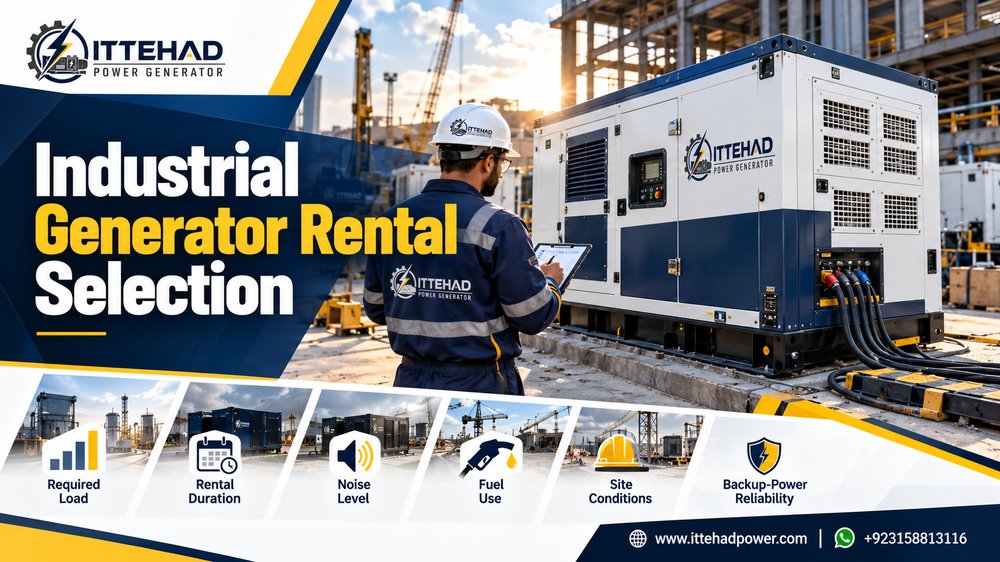
Making the right industrial generator rental selection requires more than choosing a generator with a high power rating. The rental unit should match the actual electrical load, expected operating hours, rental duration, site conditions, noise requirements, fuel planning, cabling, and backup-power needs. Careful selection helps maintain dependable power, control unnecessary fuel and rental costs, reduce overload risk, and avoid downtime caused by an incorrectly sized or poorly planned generator setup.
Why Industrial Generator Rental Selection Matters
Industrial power requirements can change considerably depending on the connected equipment and how it operates. A generator that appears suitable based only on total equipment ratings may struggle when large loads start together or when demand changes suddenly.
An unsuitable rental generator can lead to unstable operation, excessive fuel consumption, repeated protective trips, inconvenient noise, difficult cabling, or insufficient backup capacity. Proper planning helps address these issues before the generator arrives at the site.
Industrial Generator Rental Selection for Reliable Power
Effective industrial generator rental selection starts with understanding how much power is actually required and how the generator will be used. Capacity should then be considered together with rental duration, load changes, fuel availability, installation space, ventilation, cable distance, and operating support.
The objective is to choose a generator that can handle the intended demand reliably without unnecessary oversizing or avoidable operating expense.
Start With an Accurate Load Assessment
Generator sizing should begin with a list of everything that will receive power from the rental unit. Each connected load should be considered according to its normal operating requirement and, where relevant, its startup demand.
A useful load assessment can include:
- Equipment that must operate continuously
- Equipment used only occasionally
- Loads that may operate at the same time
- Starting demand of relevant equipment
- Expected maximum operating load
- Changes in demand during the working period
- Essential loads that cannot be interrupted
This information provides a better basis for generator selection than estimating capacity from a limited number of devices.
Running Load and Starting Load Are Different
Some equipment requires significantly more power during startup than during normal operation. This temporary demand must be considered when choosing a rental generator.
If starting requirements are ignored, the generator may experience excessive voltage drop, poor response, overload warnings, or protective shutdown when equipment starts.
A suitable generator should therefore be selected according to both normal running demand and realistic peak requirements.
Avoid an Undersized Industrial Generator
Choosing a generator that is too small can affect reliability and may leave insufficient capacity for changing operating conditions.
Possible signs of inadequate generator capacity include:
- Repeated overload indications
- Voltage becoming unstable as load increases
- Difficulty starting connected equipment
- Generator struggling when multiple loads operate together
- Frequent protective trips
- Unstable engine response under demand
Correcting an undersized setup may require changing the generator or reducing the connected load.
Avoid Excessive Generator Oversizing
A generator much larger than the actual requirement may increase rental costs and fuel use without providing meaningful operational benefit.
Capacity should include a sensible operating margin, but excessive oversizing should not replace proper load calculation. Matching the rental unit more closely to expected demand can improve cost control and make fuel planning easier.
Consider How the Load Changes During Operation
Industrial loads are not always constant. Equipment may start and stop throughout the day, causing significant changes in demand.
Before selecting the generator, consider:
- Which loads start first
- Whether several loads may start together
- Maximum expected simultaneous demand
- Whether large loads cycle repeatedly
- Whether future load may be added during the rental
Understanding the load profile helps ensure the generator can respond to real operating conditions rather than only an average figure.
Rental Duration Affects Generator Planning
The expected rental period influences cost, fuel arrangements, maintenance, and operating support. A short temporary requirement may need a different approach from a generator expected to operate for an extended period.
Clarify the following before arranging the rental:
- Required delivery date
- Expected rental period
- Daily operating hours
- Continuous or intermittent use
- Standby or regular operation
- Possibility of extending the rental
Accurate duration planning can help avoid unnecessary extensions, interruptions, or changes after installation.
Continuous Operation Versus Standby Rental
A generator intended for regular operation may have different requirements from one kept primarily for backup. Daily running hours, fuel consumption, inspection requirements, and maintenance planning all become more important as operating time increases.
The rental provider should understand how the unit will actually be used before recommending capacity and service arrangements.
Noise Level and Industrial Generator Selection
Noise should be considered when the generator will operate close to occupied spaces, neighboring properties, work areas, or locations where reduced sound is important.
Actual noise can be influenced by:
- Generator enclosure
- Generator size
- Operating load
- Distance from occupied areas
- Nearby walls and structures
- Placement and orientation
- Condition of the enclosure and exhaust system
If noise is an important requirement, it should be discussed before the rental unit is selected rather than after installation.
Fuel Consumption and Operating Cost
Fuel is a major part of generator operating cost. Consumption depends on generator capacity, connected load, engine condition, and running hours.
Fuel planning should consider:
- Expected average load
- Daily operating hours
- Generator capacity
- Fuel tank size
- Refueling frequency
- Safe fuel access
- Expected rental duration
A correctly sized generator can make fuel planning more predictable and reduce unnecessary consumption associated with excessive capacity.
Fuel Tank Capacity and Refueling Planning
The onboard fuel tank should provide a practical operating period between refueling cycles. If long running hours are expected, fuel supply and refueling access should be planned before operation begins.
Allowing a generator to run out of fuel can create avoidable downtime and may require additional steps before reliable operation resumes.
Site Conditions Affect Generator Suitability
The installation location can influence generator performance, accessibility, ventilation, noise, cabling, maintenance, and refueling.
Before delivery, review:
- Available installation space
- Ground condition
- Delivery access
- Ventilation
- Exhaust direction
- Distance from the electrical load
- Refueling access
- Maintenance access
- Potential exposure to dust or water
A suitable generator still requires a suitable operating location.
Ventilation and Cooling Requirements
Industrial generators produce heat during operation and require adequate cooling airflow. Restricted ventilation can contribute to overheating and protective shutdown.
The generator should be positioned so that air inlets and outlets remain unobstructed. Exhaust gases must also be directed safely away from occupied or unsuitable enclosed areas.
Generator placement should never sacrifice ventilation simply to reduce visibility or noise.
Ground and Placement Considerations
The generator should be placed on a stable and suitable surface. Uneven or unsuitable ground can affect safe positioning, access, and overall installation quality.
The location should also allow sufficient space around the generator for inspection, cable connections, refueling, and necessary maintenance during the rental period.
Cabling Is a Critical Part of Rental Planning
The generator cannot provide dependable power if the cable arrangement is unsuitable. Cable length, capacity, connections, and routing should be determined before installation.
Important cabling considerations include:
- Total cable length
- Expected electrical current
- Cable capacity
- Connection type
- Distribution requirements
- Protection from physical damage
- Safe cable routing
- Condition of terminals and connectors
Correct cabling supports both electrical performance and safer generator operation.
Keep Cable Distance Practical
Generator location should be planned with the connected load in mind. An unnecessarily long cable route can increase installation complexity and may create additional electrical considerations.
Where possible, balance ventilation, access, noise requirements, and safe placement with a practical cable distance.
Confirm Voltage and Electrical Requirements
The generator must match the electrical requirements of the connected equipment and distribution arrangement. Voltage and connection requirements should be confirmed before delivery.
Important details can include:
- Required operating voltage
- Expected load
- Connection arrangement
- Distribution method
- Available connection points
- Protective requirements
Confirming these details early helps prevent installation delays and unsuitable generator selection.
Backup-Power Reliability Should Be Verified
A rental generator should be ready to start, produce stable output, and support the intended load when required. Capacity alone does not confirm reliability.
Before regular use, useful checks can include:
- Starting performance
- Engine operating condition
- Control panel status
- Fuel and fluid levels
- Visible leakage
- Unusual noise or vibration
- Electrical output stability
- Response to load
Testing provides greater confidence that the generator is suitable for actual operation.
Generator Condition Before Rental
A rental unit should be inspected before delivery or before being placed into regular service. Worn components, weak batteries, fluid leaks, damaged connections, or control faults can reduce reliability even if the generator has sufficient capacity.
Preventive inspection is especially important when the generator will be used for extended periods or where interruption would create significant operational problems.
Benefits of Proper Industrial Generator Rental Selection
Careful planning can provide practical operational and financial benefits.
- Supports reliable electrical supply
- Reduces overload risk
- Helps control rental costs
- Supports better fuel planning
- Improves site and cable preparation
- Reduces unnecessary generator oversizing
- Helps prevent installation delays
- Improves confidence in backup-power readiness
- Reduces avoidable downtime
What Customers Need From an Industrial Generator Rental Service
Customers need more than an available generator. They need guidance that connects generator capacity with their actual operating requirements.
A useful rental service should help with:
- Load assessment
- Generator sizing
- Rental duration planning
- Fuel requirements
- Noise considerations
- Site inspection
- Cabling requirements
- Electrical connection planning
- Operational guidance
- Technical support during the rental period
Clear planning before delivery can reduce uncertainty and improve the overall rental experience.
A Practical Industrial Generator Rental Selection Process
A structured approach makes generator selection easier and reduces the risk of important details being missed.
- List the required electrical loads: Identify all equipment expected to receive generator power.
- Calculate normal demand: Determine the typical running load.
- Review starting requirements: Account for temporary demand when relevant equipment starts.
- Determine operating pattern: Identify continuous, intermittent, or standby use.
- Confirm rental duration: Estimate daily operating hours and total rental period.
- Inspect the site: Check access, ventilation, available space, ground condition, and cable routing.
- Review fuel requirements: Estimate consumption and plan refueling.
- Confirm electrical connections: Check voltage, cabling, and distribution requirements.
- Select suitable capacity: Choose a generator with appropriate capacity and operating margin.
- Test the generator: Verify starting, output, controls, and performance after installation.
How to Compare Industrial Generator Rental Options
Rental price should be considered together with suitability, operating condition, fuel requirements, and support. The cheapest unit may not provide good value if it is too large, too small, poorly maintained, or unsuitable for the intended application.
Compare rental options based on:
- Generator capacity
- Condition of the rental unit
- Expected fuel use
- Rental terms
- Cabling requirements
- Delivery and installation arrangements
- Noise characteristics
- Maintenance support
- Fault response during the rental period
Selection Tips for Better Rental Value
Good generator rental value comes from choosing equipment that closely matches the actual requirement and is supported throughout the rental period.
Useful selection tips include:
- Calculate load before requesting a generator
- Include relevant starting demand
- Avoid unnecessary oversizing
- Confirm daily operating hours
- Plan fuel requirements in advance
- Inspect the intended generator location
- Confirm cable distances before delivery
- Check electrical connection requirements
- Understand technical support arrangements
- Verify generator condition before regular use
Site and Local Operating Conditions
Local site conditions can influence generator selection even when the required electrical load remains the same. High temperatures, dust, restricted space, difficult access, long cable routes, and challenging refueling conditions can all affect the most suitable rental arrangement.
Generator selection should therefore consider the actual environment where the unit will operate rather than treating every installation as identical.
Hot Operating Conditions
High ambient temperatures can increase cooling demands. Generator ventilation and airflow should receive particular attention in hot operating environments.
Dusty Conditions
Dust can affect filters, cooling airflow, and general generator cleanliness. Rental units operating in dusty conditions may require more frequent inspection during longer rental periods.
Restricted Site Access
Delivery route, generator dimensions, lifting or positioning requirements, and service access should be checked before dispatch. A suitable generator cannot be used effectively if it cannot be positioned safely at the intended location.
Trust Points When Choosing a Rental Provider
A dependable rental provider should explain why a particular generator is being recommended rather than simply supplying an available unit.
Important trust points include:
- Load requirement discussed before selection
- Suitable generator capacity recommended
- Generator condition checked
- Rental terms explained clearly
- Fuel requirements discussed
- Cabling and connection needs confirmed
- Site conditions considered
- Testing completed after installation where required
- Technical support available for generator faults
Questions to Clarify Before Confirming the Rental
Providing complete information helps the rental provider recommend a more suitable generator.
Before confirming, clarify:
- What equipment will receive power
- Maximum expected load
- Any significant starting requirements
- Daily running hours
- Total rental duration
- Available installation space
- Distance from generator to load
- Required voltage and connections
- Noise requirements
- Fuel and refueling arrangements
- Whether continuous backup is required
Planning for Long-Term Industrial Generator Rental
Longer rental periods require additional attention to fuel, inspection, maintenance, and operating records. A generator that runs for extended periods may require servicing during the rental.
For longer use, discuss:
- Expected operating hours
- Service intervals
- Maintenance responsibility
- Filter and fluid requirements
- Fuel arrangements
- Routine inspection schedule
- Repair support
- Replacement arrangements if a major fault occurs
These details can help maintain consistent performance throughout the rental period.
Why Repair and Support Response Matters
Even a well-maintained generator can develop an unexpected fault. The rental arrangement should therefore include a clear understanding of how technical problems will be handled.
Customers should know how to report faults, what initial checks may be required, and how repair or replacement decisions will be managed if the generator cannot continue operating.
Guidance for Safe Rental Generator Operation
Industrial generator operation involves electricity, fuel, hot components, exhaust gases, and moving parts. Suitable safety practices should be followed throughout the rental period.
Important operating guidance includes:
- Maintain suitable ventilation
- Keep electrical connections protected
- Use suitable cables
- Maintain safe refueling practices
- Keep generator access clear
- Do not bypass protective devices
- Monitor warning indications
- Stop operation if serious leakage, overheating, smoke, or electrical burning signs appear
Unsafe temporary modifications should not be used to keep a generator operating.
Common Industrial Generator Rental Selection Mistakes
Many rental problems can be avoided during the planning stage.
Common mistakes include:
- Guessing generator size without calculating load
- Ignoring starting demand
- Choosing excessive capacity without a reason
- Failing to confirm voltage requirements
- Planning cable length after generator delivery
- Ignoring ventilation needs
- Underestimating daily fuel requirements
- Not considering delivery access
- Ignoring noise requirements
- Failing to confirm technical support
Addressing these points before rental can reduce costly or inconvenient changes later.
When Professional Rental Assessment Is Recommended
Professional generator selection assistance is particularly useful when the electrical load is large, multiple pieces of equipment will operate together, startup demand is uncertain, cable runs are long, or the generator will operate for an extended period.
A proper assessment can help determine a suitable generator capacity and identify installation requirements before the rental begins.
Final Guidance for Industrial Generator Rental Selection
Successful industrial generator rental selection depends on matching generator capacity with actual load while also considering rental duration, noise level, fuel consumption, site conditions, ventilation, cabling, connection requirements, and backup-power reliability. Each factor should be confirmed before the generator is delivered whenever possible.
If you need dependable temporary or backup power, arrange a proper load and site assessment before confirming the rental unit. Careful selection can help provide stable generator performance, control operating costs, simplify installation, and reduce avoidable downtime throughout the rental period.