
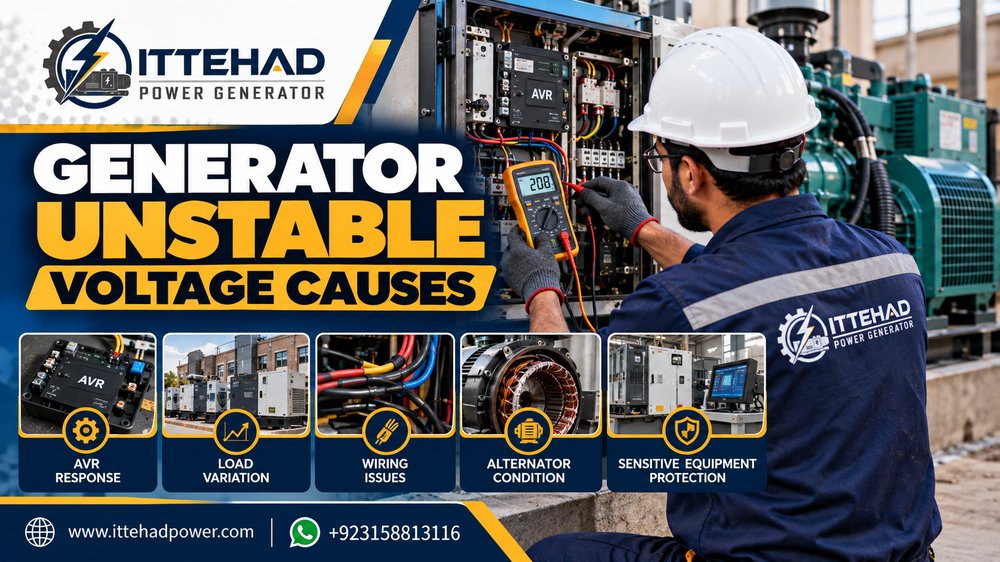
Understanding generator unstable voltage causes helps commercial and industrial generator users identify why electrical output rises, falls, fluctuates, or changes unexpectedly during operation. Voltage instability can be linked to AVR response, sudden load variation, engine-speed changes, loose wiring, poor electrical connections, alternator condition, excitation problems, cable voltage drop, or faults within the connected system. A structured diagnosis is important because unstable generator voltage can affect operating reliability and place sensitive electrical equipment at risk if the underlying problem is ignored.
Why Generator Voltage Stability Matters
A generator should maintain electrical output within a suitable range while load conditions change. Small variations can occur during normal operation, especially when larger electrical loads start or stop, but repeated or excessive voltage movement can indicate a fault that requires investigation.
Stable voltage is particularly important where connected equipment depends on consistent electrical supply. If voltage repeatedly rises or falls outside acceptable operating conditions, equipment performance may become unreliable and generator components can experience additional stress.
Common Generator Unstable Voltage Causes
The most common generator unstable voltage causes are usually related to voltage regulation, changing electrical load, engine speed, excitation, alternator condition, electrical wiring, or connection quality.
- Slow or faulty AVR response
- Rapid changes in electrical load
- Incorrect or unstable engine speed
- Loose electrical terminals
- Damaged sensing connections
- Weak excitation
- Alternator winding problems
- Unbalanced phase loading
- Incorrect cable sizing
- Excessive cable voltage drop
- Poor grounding
- Intermittent breaker or connection faults
What Unstable Generator Voltage Looks Like
Voltage instability does not always appear as a constant low or high reading. It may fluctuate around the normal value, drop suddenly when load is added, rise sharply when load is removed, or move differently between phases.
Typical Signs of Voltage Instability
- Voltage meter readings moving continuously
- Sudden voltage drop under load
- Voltage overshoot when load is removed
- Different voltage readings between phases
- Connected equipment behaving inconsistently
- Repeated control-panel voltage warnings
- Lights changing brightness
- Electrical equipment restarting unexpectedly
- Voltage becoming unstable after the generator warms up
- Voltage improving or worsening as load changes
Automatic Voltage Regulator Response
The automatic voltage regulator, or AVR, is one of the main components responsible for maintaining generator output voltage. It monitors generator output and adjusts excitation to keep voltage within the required range.
If the AVR responds too slowly, receives incorrect sensing information, or develops an internal fault, voltage may fluctuate as electrical demand changes.
Possible AVR-Related Symptoms
- Voltage repeatedly rises and falls
- Output changes even when load is relatively stable
- Voltage takes too long to recover after a load change
- Voltage overshoots after a large load disconnects
- Generator frequency remains stable while voltage fluctuates
- Voltage adjustment does not remain consistent
AVR Sensing Problems
The AVR depends on accurate sensing signals. Loose terminals, damaged wires, poor connectors, or incorrect sensing points can cause the regulator to receive unstable information.
When the sensing signal changes unexpectedly, the AVR may continually adjust excitation, creating unstable output even though the alternator and engine are otherwise operating normally.
Do Not Replace the AVR Without Testing
Voltage instability is often blamed on the AVR first, but many other problems can produce similar symptoms. Engine-speed variation, excitation faults, loose wiring, excessive load changes, damaged alternator components, or poor electrical connections can all affect voltage stability.
The AVR should therefore be tested as part of a complete diagnostic process rather than replaced automatically.
Rapid Generator Load Variation
Electrical loads can change quickly when equipment starts, stops, or cycles. The generator must respond to these changes by adjusting both engine power and electrical excitation.
Large or repeated load changes can cause short-term voltage movement, especially if the generator is operating close to its capacity.
Load Conditions That Can Affect Voltage
- Large equipment starting suddenly
- Several loads starting at the same time
- Heavy electrical loads disconnecting abruptly
- Frequent on-and-off cycling
- Generator operating close to maximum capacity
- Uneven load distribution between phases
Generator Overloading
A generator carrying excessive load may struggle to maintain stable voltage. Engine speed can decrease, alternator current can rise, and voltage regulation may become less consistent.
If voltage becomes unstable mainly during high electrical demand, actual load should be measured and compared with generator capacity.
Possible Signs of Overloading
- Voltage falls as more load is connected
- Frequency also decreases
- Engine sound changes significantly
- Generator temperature rises
- Breaker trips occur
- Voltage recovers when load is reduced
Generator Engine Speed Variation
Stable engine speed is essential for stable electrical frequency and can also influence voltage regulation. If engine speed hunts, surges, or falls under load, electrical output may become unstable.
Engine-speed problems should be considered especially when voltage fluctuation occurs together with changing frequency.
Frequency as a Diagnostic Clue
Frequency provides useful information during voltage troubleshooting. If both voltage and frequency fluctuate together, the problem may involve engine speed, fuel delivery, load variation, or governor response.
If frequency remains stable while voltage changes significantly, electrical regulation, excitation, alternator condition, or wiring becomes more likely.
Fuel Supply Problems and Voltage Instability
A generator engine that does not receive consistent fuel may have difficulty maintaining stable speed. Restricted filters, poor fuel flow, air entering the fuel system, or other fuel-delivery problems can cause engine output to vary under demand.
If voltage and frequency fluctuate together, the fuel system should be included in the diagnosis.
Air Intake Restriction
An engine needs sufficient airflow to maintain stable performance under load. A heavily restricted air filter may reduce engine response when electrical demand changes.
This can contribute indirectly to unstable voltage if engine speed cannot remain consistent.
Governor Response and Engine Stability
The engine governor helps maintain the required operating speed as load changes. If governor response is slow, unstable, or incorrectly adjusted, engine speed can rise and fall repeatedly.
Voltage instability associated with frequency movement should therefore include engine governing in the diagnostic process.
Generator Excitation Problems
The excitation system controls the magnetic field required for alternator output. If excitation becomes weak or intermittent, generator voltage can fluctuate even when engine speed remains stable.
Excitation problems may involve AVR output, exciter components, field wiring, rotating rectifiers, brushes and slip rings where applicable, or other connected components.
Intermittent Excitation Connections
A loose excitation wire or damaged connector can make voltage appear normal at one moment and unstable the next. Vibration may make the condition worse during operation.
Excitation wiring should be inspected for secure terminals, damaged insulation, overheated connectors, and poor contact.
Rotating Rectifier Problems
Brushless alternators may use rotating rectifier components as part of the excitation system. A failing diode or poor rectifier connection can affect field current and cause unstable generator output.
These components should be tested by qualified personnel using suitable electrical procedures.
Brushes and Slip Rings Where Applicable
In generator designs that use brushes and slip rings, worn brushes, contaminated slip-ring surfaces, or weak contact can create inconsistent excitation.
Voltage may fluctuate as contact quality changes during operation, particularly if components are heavily worn or contaminated.
Alternator Winding Condition
Alternator winding faults can cause unstable or unbalanced voltage. Internal winding deterioration, insulation problems, loose internal connections, or partial faults may not always produce complete output failure.
When external connections, load, AVR, and excitation systems appear normal, alternator testing may be required.
Possible Alternator-Related Warning Signs
- Unstable voltage with normal engine frequency
- Different voltage between phases
- Alternator overheating
- Electrical smell
- Repeated voltage faults
- Voltage becoming less stable after extended operation
- Abnormal resistance or insulation readings
Loose Electrical Connections
Loose generator terminals can cause intermittent voltage drop and localized heating. Vibration, thermal expansion, previous maintenance, or poor cable support can gradually reduce connection quality.
Main output terminals, breaker connections, cable lugs, AVR wiring, sensing connections, and control terminals should all be inspected when voltage is unstable.
Heat-Damaged Connections
A poor connection can generate heat as current flows through it. Over time, heat may damage the terminal surface, cable lug, insulation, or connector.
Warning Signs of Connection Heating
- Darkened terminals
- Melted insulation
- Burned cable lugs
- Electrical smell
- Discolored connectors
- Localized temperature increase
- Intermittent output under load
Simply tightening a heat-damaged connection may not be enough. The affected parts should be inspected to determine whether replacement or repair is required.
Generator Breaker Connections
The main output breaker can also contribute to unstable voltage if terminals are loose, internal contacts are damaged, or heat has affected the connection.
Voltage measurements before and after the breaker can help identify whether instability is occurring at this point in the electrical path.
Power Cable Condition
Damaged or undersized cables can contribute to voltage problems, particularly under changing load. Loose cable lugs, long cable runs, poor joints, or damaged insulation can increase resistance and cause voltage drop.
Generator output voltage and load-end voltage should be compared where cable-related loss is suspected.
Voltage Drop Over Long Cable Runs
Long electrical cable runs naturally increase resistance. If conductor size is not suitable for current and distance, voltage at the connected load may fluctuate more noticeably as demand changes.
Correct cable sizing and secure connections are therefore important for stable power delivery.
Unbalanced Three-Phase Loads
Where applicable, significant differences in current between phases can result in unequal voltage behavior and additional alternator heating.
Individual phase voltage and current readings should be compared when only one phase appears unstable or when connected loads are unevenly distributed.
One Phase Unstable While Others Remain Normal
If instability affects only one phase, the fault may involve a connection, cable, breaker contact, winding, or uneven electrical load associated with that phase.
Phase-by-phase measurements can help isolate the affected part of the system.
All Phases Fluctuating Together
If all output phases rise and fall together, common causes may include AVR response, excitation, engine-speed variation, major load changes, or a shared alternator problem.
Comparing frequency movement with voltage fluctuation can help narrow the diagnosis.
Grounding and Electrical Stability
Grounding should be secure and suitable for the generator electrical system. Damaged or loose grounding connections can contribute to unsafe conditions and may affect how faults appear in the electrical network.
Grounding points should be included in a complete electrical inspection, especially where repeated or unexplained electrical behavior is present.
Control Wiring and Signal Instability
Generator control systems depend on stable electrical signals. Loose control wiring, damaged sensor connections, or poor connectors may affect voltage regulation commands or fault monitoring.
Control-panel wiring should therefore be inspected when voltage instability is intermittent or difficult to reproduce.
Voltage Instability During Generator Warm-Up
Some voltage problems appear only as the generator reaches operating temperature. Electrical connections can expand, resistance can change, and AVR or alternator components may behave differently when hot.
If output is stable when cold but becomes unstable later, temperature-related testing can help identify the fault.
Generator Temperature and Voltage Performance
High generator temperature can affect engine performance, alternator condition, electrical connections, and voltage-regulation components.
Cooling airflow, ventilation, electrical load, and alternator temperature should be reviewed when voltage instability develops after prolonged operation.
Alternator Cooling and Ventilation
The alternator needs adequate airflow to manage electrical heat. Blocked ventilation openings, dust buildup, or poor surrounding airflow can increase operating temperature.
Keeping alternator cooling paths reasonably clean can support more stable electrical performance.
Dust and Electrical Components
Dust can accumulate around alternator openings, AVR areas, terminals, and control components. Combined with heat or moisture, contamination can contribute to poor electrical reliability.
Routine cleaning and inspection make it easier to identify loose or damaged connections before they create unstable output.
Moisture and Voltage Instability
Moisture can affect electrical terminals, insulation, connectors, and alternator windings. Corrosion or contamination may create intermittent contact or leakage paths.
Generators operating or stored in damp environments may require closer inspection of electrical components and insulation condition.
Sensitive Equipment and Generator Voltage Quality
Sensitive electrical equipment can react more noticeably to voltage fluctuations than basic resistive loads. Repeated undervoltage, overvoltage, or rapid voltage movement may cause unstable operation, protective shutdowns, or reduced equipment reliability.
When sensitive equipment is connected, generator voltage quality should be verified under realistic operating conditions before relying on the power supply.
Protecting Sensitive Equipment
Protection begins with a generator that is correctly sized, properly maintained, and producing stable voltage and frequency. Electrical loads should also be connected in a way that avoids unnecessary sudden demand changes where possible.
- Verify generator capacity
- Check voltage and frequency stability
- Inspect AVR operation
- Review electrical connections
- Avoid excessive generator loading
- Check cable sizing
- Monitor phase balance where applicable
- Test generator response to major load changes
Do Not Ignore Short Voltage Spikes or Drops
Short voltage changes may seem harmless if the generator quickly returns to normal output, but repeated events can indicate slow AVR response, large load steps, weak connections, or another developing fault.
Repeated instability should be investigated, especially if connected equipment is showing abnormal behavior.
How to Diagnose Generator Voltage Instability
A systematic process helps separate engine-related, load-related, and electrical causes.
- Measure generator voltage at no load.
- Measure operating frequency.
- Observe whether voltage changes while load remains stable.
- Add load gradually and monitor voltage response.
- Review total generator load.
- Check individual phase voltage and current where applicable.
- Inspect main electrical terminals and breaker connections.
- Review cable condition and voltage drop.
- Inspect AVR and sensing wiring.
- Evaluate excitation condition if required.
- Check alternator condition if external systems appear normal.
- Test again after corrective work.
Compare Voltage With and Without Load
No-load and loaded voltage readings provide valuable diagnostic information. A generator that remains stable without load but fluctuates under demand may have load, engine-speed, AVR-response, alternator, or connection problems.
If voltage is unstable even without external load, voltage regulation, excitation, sensing, or alternator condition may require closer attention.
Observe Voltage During Sudden Load Changes
A short voltage dip when a large load starts can be normal, but the generator should recover quickly. Excessive drop, slow recovery, or repeated oscillation suggests that generator response should be investigated.
The size of the starting load should also be compared with generator capacity.
Monitor Frequency at the Same Time
Voltage alone does not provide a complete picture. Recording frequency during the same event can reveal whether the engine is also struggling.
This distinction can prevent unnecessary electrical component replacement when the true problem is engine speed or load demand.
Benefits of Accurate Voltage Instability Diagnosis
- Improved power quality: Stable output supports more dependable connected equipment operation.
- Reduced unnecessary repairs: Testing helps identify the actual cause before parts are replaced.
- Better generator protection: Overload, overheating, and connection faults can be identified earlier.
- Reduced downtime: Systematic diagnosis can avoid repeated unsuccessful repair attempts.
- Improved sensitive-equipment protection: Voltage fluctuations can be addressed before they become persistent.
- Better maintenance planning: Repeated voltage behavior can be documented and monitored.
- Greater operating confidence: Generator response can be verified under realistic electrical load.
What Commercial and Industrial Generator Users Need
Commercial and industrial users need reliable voltage under both steady and changing load conditions. They also need clear diagnosis that distinguishes generator faults from cable, connection, or load-related issues.
A professional inspection should explain what is causing the instability, which system needs attention, and how generator performance will be verified after repair.
How to Select a Voltage Troubleshooting Service
Generator voltage problems should be handled by technicians who understand AVR systems, excitation, alternators, engine speed, electrical load, wiring, cables, and safe testing.
- Ask whether voltage and frequency will be measured together.
- Confirm that load variation will be reviewed.
- Ask whether phase currents will be checked where applicable.
- Confirm that AVR and sensing circuits can be inspected.
- Ask whether excitation can be tested if required.
- Confirm that alternator condition can be assessed.
- Ask whether electrical connections and cables will be inspected.
- Request post-repair testing under appropriate load.
Do Not Correct Voltage Instability by Adjustment Alone
Changing an AVR setting may alter the output temporarily, but adjustment will not correct loose connections, engine-speed variation, overload, damaged sensing wiring, or internal alternator faults.
The cause should be identified before voltage settings are changed.
Do Not Keep Resetting Voltage Fault Warnings
Repeated generator warnings indicate that an operating condition is outside the expected range. Resetting the warning without diagnosis may allow the problem to continue and become more difficult to repair.
Record the warning and note the load, voltage, frequency, and operating conditions at the time it occurs.
Safe Generator Voltage Testing
Voltage troubleshooting can involve hazardous electrical energy. Live voltage measurements, AVR testing, alternator checks, and excitation diagnosis should be performed only by qualified personnel using suitable test equipment and safe procedures.
Generator users should avoid touching exposed terminals or attempting internal adjustments while the equipment is energized.
Operating Environment and Voltage Stability
Generator voltage stability can be influenced by the actual operating environment. Heat, dust, moisture, ventilation, long cable runs, high load, and extended operating periods may expose electrical weaknesses that are not obvious during short tests.
Diagnosis should therefore consider actual site conditions rather than evaluating electrical output in isolation.
High Ambient Temperature
High surrounding temperature can increase alternator, engine, and electrical component heat. Voltage-regulation problems may become more noticeable when the generator has been operating for a long period.
Cooling and ventilation should be checked if voltage instability increases with temperature.
Long Operating Hours
Generators that run for extended periods can develop heat-related connection, alternator, or regulator problems that do not appear immediately after startup.
Monitoring voltage over time can help identify whether instability is related to operating duration.
Long Cable Distance
Voltage at the generator output may remain stable while voltage at the connected equipment changes because of cable resistance and varying electrical current.
Measurements at both ends of the electrical path can help determine whether the generator or distribution cable is responsible.
Trust Points for Professional Voltage Diagnosis
A reliable troubleshooting process should use measurements and operating evidence instead of assumptions.
- Generator voltage measured accurately
- Frequency checked at the same time
- Load conditions reviewed
- Engine-speed stability considered
- AVR response assessed
- Sensing circuits inspected
- Excitation system evaluated where required
- Alternator condition checked
- Electrical terminals and cables inspected
- Output verified after corrective work
Common Generator Voltage Troubleshooting Mistakes
- Replacing the AVR without diagnosis
- Ignoring generator frequency
- Failing to review load changes
- Overlooking loose electrical terminals
- Ignoring cable voltage drop
- Failing to compare phase readings
- Overlooking excitation problems
- Ignoring engine-speed instability
- Testing only with no load
- Returning the generator to service without verifying stability
Preventive Maintenance for Stable Generator Voltage
Routine maintenance can reduce the likelihood of unexpected voltage fluctuations.
- Monitor voltage and frequency regularly
- Inspect electrical terminals
- Check AVR and sensing connections
- Keep alternator cooling paths clean
- Maintain fuel and air systems
- Monitor generator load
- Check phase balance where applicable
- Inspect cable condition
- Record repeated voltage changes
- Test electrical output after significant maintenance
Keep Records of Voltage Problems
Voltage instability should be documented in the generator maintenance history. Record voltage readings, frequency, electrical load, phase measurements where applicable, operating temperature, symptoms, and any repairs completed.
Good records can show whether instability occurs only under certain loads, after extended running, or during specific operating conditions.
Guidance When Generator Voltage Starts Fluctuating
If generator voltage becomes unstable, observe whether frequency also changes and whether the problem appears when a particular load starts or stops. Note whether the generator is hot, heavily loaded, or showing warning indications.
This information can help technicians distinguish between AVR, excitation, alternator, wiring, engine-speed, and load-related problems.
Post-Repair Voltage Stability Testing
After corrective work, the generator should be tested through realistic load changes rather than checked only at idle or no load. Voltage should recover smoothly and remain within suitable operating limits.
Frequency, current, temperature, and electrical connection condition should also be monitored where appropriate.
Maintain Stable Generator Power
Understanding generator unstable voltage causes requires looking at the complete power-generation system, including AVR response, electrical load, engine speed, excitation, alternator health, wiring, breakers, cables, and connection quality. Systematic testing can identify whether instability originates from the generator itself or from the electrical path supplying connected equipment.
If your commercial or industrial generator is showing fluctuating voltage, repeated voltage warnings, output changes under load, phase imbalance, or unstable power to sensitive equipment, arrange a professional electrical inspection. Accurate diagnosis, suitable corrective work, and controlled post-repair testing can help restore stable generator output and improve long-term operating confidence.