
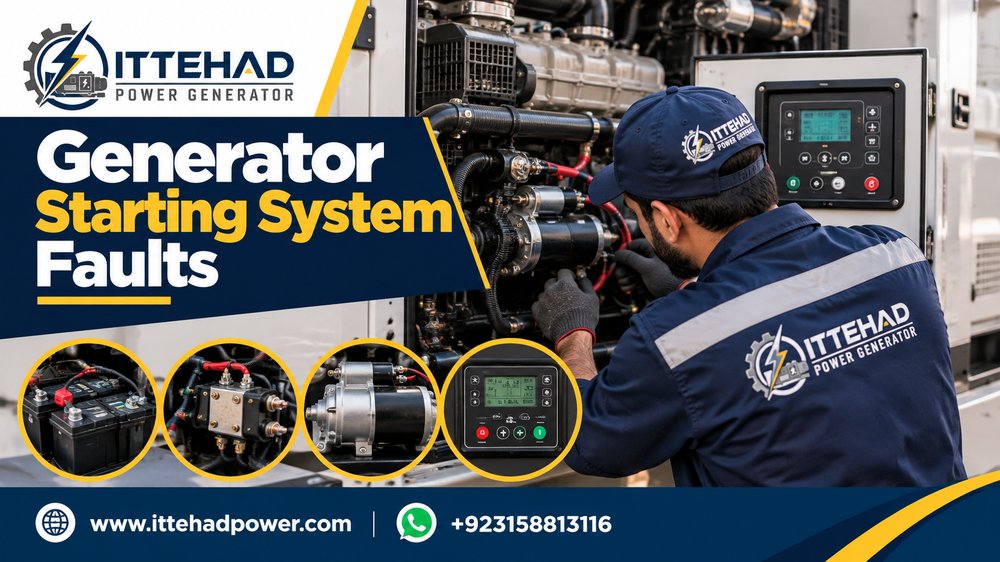
Generator starting system faults can prevent a generator from cranking, cause slow or inconsistent starting, produce repeated clicking, or allow the engine to crank without completing a normal start sequence. The starting system usually depends on the battery, cables, starter relay, starter motor, controller signals, wiring, terminals, and related start-circuit components working together. Accurate diagnosis is important because similar symptoms can come from different faults, and replacing parts without testing may not solve the problem.
Why Generator Starting System Faults Need Attention
A generator that cannot start when required is not providing dependable backup power. Starting faults should therefore be investigated early, especially when the problem is intermittent or becoming more frequent.
A weak battery, loose connection, damaged relay, worn starter motor, failed controller output, or poor wiring can all interrupt the starting sequence. A structured inspection helps identify the real cause before unnecessary parts are replaced.
Common Signs of Generator Starting Problems
Starting-system faults can appear in several ways depending on which part of the circuit is affected.
- Generator does not crank
- Starter clicks but engine does not turn
- Engine cranks slowly
- Starting is intermittent
- Generator needs several attempts before cranking
- Starter motor remains engaged too long
- Control panel shows a start-related fault
- Battery voltage drops heavily during starting
- Starter relay operates inconsistently
- Wiring or terminals become hot during cranking
Battery Problems in the Starting System
The battery provides the electrical energy required to operate the starter motor and start-control circuit. If battery condition is weak, the generator may crank slowly, click without turning, or fail to crank completely.
Low Battery Voltage
A discharged or deteriorated battery may show enough voltage at rest but drop significantly when the starter is engaged. Load-related voltage behavior should therefore be checked rather than relying only on an idle battery reading.
Battery Capacity Loss
An older or damaged battery may no longer provide enough current for reliable cranking even if it appears charged.
Repeated Battery Discharge
If the battery repeatedly becomes weak, the charging system, electrical drain, loose connections, or battery condition should be investigated rather than simply recharging it again.
Battery Terminal and Cable Faults
Corroded, loose, damaged, or undersized battery connections can create resistance in the starting circuit. This resistance can reduce starter performance even when the battery itself is healthy.
- Inspect battery terminals for corrosion
- Check cable tightness
- Look for damaged cable insulation
- Inspect cable lugs
- Check ground connections
- Look for heat damage
- Measure voltage drop where appropriate
Connections should be secure and clean enough to carry high starting current without excessive resistance.
Starter Relay Problems
The starter relay allows the control circuit to activate the starter system. If the relay fails, the generator may not crank even when the battery and starter motor are in good condition.
Relay Clicking Without Cranking
A clicking relay may indicate that the control signal is reaching the relay but the high-current side is not supplying the starter correctly. Battery condition, relay contacts, cables, and starter motor should all be considered.
No Relay Click
If the relay does not operate, the fault may involve controller output, wiring, relay coil, interlock conditions, or another control-circuit issue.
Intermittent Relay Operation
Worn internal contacts or loose wiring can cause starting to work sometimes and fail at other times.
Starter Motor Faults
The starter motor converts battery power into mechanical rotation to crank the engine. Wear, internal electrical damage, mechanical binding, or connection problems can reduce its performance.
Slow Starter Motor
Slow cranking can be caused by low battery power, voltage drop, cable resistance, starter wear, or excessive mechanical resistance.
Starter Does Not Turn
If battery voltage and control signals are correct but the starter remains inactive, the starter motor or solenoid may require further testing.
Unusual Starter Noise
Grinding, clicking, or abnormal mechanical noise during cranking can indicate engagement problems or internal starter wear.
Starter Solenoid Problems
The starter solenoid helps engage the starter and switch high current to the motor. A faulty solenoid can cause clicking, intermittent cranking, or complete starting failure.
Testing should determine whether the solenoid is receiving the correct control signal and whether it is passing current properly before replacement is recommended.
Generator Controller Start Signal
The generator controller is often responsible for sending the command that begins the starting sequence. If the controller does not provide the required signal, the starter relay and motor may never be activated.
The control panel should be checked for fault codes, inhibit conditions, incorrect settings, or missing output signals where starting does not begin.
Control Wiring Faults
Small control wires can be just as important as heavy battery cables. Broken conductors, loose terminals, corroded connectors, or damaged insulation can interrupt the signal between the controller, relay, solenoid, and starter.
- Inspect control wiring for damage
- Check connectors and terminals
- Look for corrosion
- Confirm relay-coil wiring
- Check controller output connections
- Inspect repaired or modified wiring carefully
Ground Connection Problems
The starting circuit depends on a complete electrical path. A poor ground connection can cause slow cranking, intermittent starting, or complete starter failure.
Ground straps, battery negative connections, engine grounding, and related terminals should be inspected for looseness, corrosion, heat, or damage.
Start Circuit Fuse and Protection Faults
Some starting circuits include fuses or protective devices. If a fuse opens or a protective component fails, the control circuit may not activate the starter.
A blown fuse should not simply be replaced without considering why it failed, particularly if the replacement opens again.
Interlock and Shutdown Conditions
A generator may refuse to crank because the control system is intentionally preventing startup. Active shutdown conditions, emergency stop circuits, or protection interlocks can interrupt the starting sequence.
These conditions should be identified and corrected instead of bypassed, because they may be protecting the generator from another fault.
Emergency Stop Circuit Problems
If an emergency stop circuit remains active or has a wiring fault, the controller may block the start command. The emergency stop condition and its wiring should be checked when the generator appears electrically healthy but does not crank.
Charging System and Starting Reliability
The charging system supports battery readiness between starts. A weak charging system can allow the battery to become gradually discharged until starting problems begin.
Battery charging voltage, charger condition, wiring, and connections should be reviewed when starting reliability declines over time.
Parasitic Electrical Drain
A battery may become weak even when the charger appears normal if an unintended electrical load continues drawing power while the generator is off.
Repeated battery discharge should therefore be investigated for both charging problems and excessive standby current.
Cold or High-Resistance Cranking Conditions
Any condition that increases the mechanical effort required to crank the engine can place additional demand on the starting system. When electrical components are already marginal, the generator may fail to crank properly.
Battery condition, cable resistance, starter performance, and mechanical condition should be considered together when slow cranking occurs.
How Voltage Drop Affects Generator Starting
Voltage drop can occur across cables, terminals, relays, solenoids, or ground connections. A circuit may show correct battery voltage before starting but lose too much voltage once high current begins flowing.
Voltage-drop testing can help locate resistance that is not obvious during visual inspection.
Generator Starting System Diagnosis Process
A structured diagnostic process helps separate battery, wiring, relay, controller, and starter faults.
- Confirm the exact starting symptom.
- Check the generator control panel for alarms or inhibit conditions.
- Measure battery condition.
- Inspect battery terminals and cables.
- Check ground connections.
- Confirm starter relay operation.
- Check controller start signal where required.
- Inspect control wiring and connectors.
- Test voltage at the starter during cranking.
- Check starter solenoid operation.
- Evaluate starter motor condition.
- Review charging-system performance.
- Correct the confirmed fault.
- Test repeated starting after repair.
Why Symptom Timing Matters
The exact behavior of the generator during the start attempt can provide useful clues.
No Sound at All
This can point toward a missing control signal, open circuit, active interlock, discharged battery, or failed relay circuit.
Single Click
A single click may indicate relay or solenoid activation without sufficient current reaching the starter motor.
Repeated Clicking
Repeated clicking often suggests low available voltage, weak battery condition, or high resistance in the starting circuit.
Slow Cranking
Slow cranking can result from weak battery output, cable resistance, poor ground, starter wear, or excessive mechanical load.
Why Replacing the Battery First Is Not Always the Answer
A weak battery can cause starting faults, but a new battery will not correct loose terminals, poor charging, damaged cables, parasitic drain, faulty relays, or starter problems.
Testing the complete starting circuit prevents unnecessary battery replacement and helps reduce repeated failures.
Why Replacing the Starter Motor Without Testing Can Be Costly
Starter motors are often blamed when an engine does not crank, but many no-crank problems originate elsewhere in the circuit.
Battery voltage, cable condition, relay operation, solenoid control, and ground connections should be checked before a starter motor is replaced.
Benefits of Accurate Starting System Diagnosis
Correct diagnosis helps restore dependable generator starting while avoiding unnecessary parts replacement.
- Improves starting reliability
- Reduces repeated no-start faults
- Identifies weak electrical connections
- Helps prevent unnecessary battery replacement
- Reduces unnecessary starter replacement
- Supports reliable controller operation
- Improves maintenance planning
- Helps identify charging problems early
What Customers Need When a Generator Will Not Start
Customers generally need to know whether the problem is caused by the battery, relay, starter motor, wiring, controller, or another part of the starting circuit.
A useful service should explain the cause clearly and identify whether repair, adjustment, wiring correction, battery replacement, or starter-component replacement is actually required.
How to Select a Generator Starting System Service
Starting problems should be handled by a service that can test the complete electrical starting circuit rather than replacing components based only on symptoms.
Choose Battery Testing Under Load
The battery should be evaluated during starting conditions where appropriate, not only with a simple resting-voltage check.
Ask for Cable and Ground Inspection
High-resistance connections are common causes of starting problems and should not be overlooked.
Confirm Relay and Controller Testing
The service should determine whether the start command is reaching the relay and starter circuit correctly.
Ask for Starter Motor Verification
The starter motor should be tested before replacement is recommended.
Confirm Repeated Start Testing
After repair, the generator should be started several times where appropriate to confirm that the fault has been resolved consistently.
Site-Specific Relevance of Starting System Faults
Generator starting reliability can be influenced by operating environment, maintenance history, battery age, vibration, wiring condition, storage period, and how frequently the generator is exercised.
On-site diagnosis can be valuable because the generator can be tested with its actual battery, control system, wiring, charger, and installation conditions still connected.
Trust Points in Starting System Troubleshooting
Professional diagnosis should follow the electrical path from the battery to the starter rather than assuming one component has failed.
- Battery condition is verified
- Terminals and cables are inspected
- Ground connections are checked
- Relay and solenoid operation are tested
- Controller start signals are confirmed
- Wiring faults are considered
- Unnecessary parts replacement is avoided
- Starting reliability is tested after repair
Common Starting System Repair Mistakes
Incorrect troubleshooting can increase repair cost and leave the original fault unresolved.
- Replacing the battery without checking charging condition
- Replacing the starter without checking voltage drop
- Ignoring corroded terminals
- Overlooking poor ground connections
- Changing the relay without testing controller signals
- Bypassing safety interlocks
- Ignoring repeated battery discharge
- Skipping repeated start testing after repair
Guidance When a Generator Fails to Crank
When the generator does not crank, note whether the control panel activates, whether a relay or solenoid clicks, whether lights dim, and whether any fault message appears.
Avoid repeated long cranking attempts when the starter is operating slowly or electrical connections are heating. Excessive cranking can increase stress on the battery, cables, solenoid, and starter motor.
How to Reduce Generator Starting Problems
Routine inspection can help identify weak starting-system components before the generator fails to start.
- Maintain battery charge
- Keep terminals clean and secure
- Inspect battery cables
- Check ground connections
- Monitor charging-system performance
- Investigate slow cranking early
- Inspect starter wiring and relays
- Exercise the generator appropriately
When Starting System Faults Need Prompt Repair
Prompt inspection is recommended when the generator repeatedly fails to crank, starting becomes noticeably slower, cables or terminals become hot, the starter produces abnormal noise, or control-panel start faults appear.
Intermittent faults should also be investigated because they can develop into complete starting failure without warning.
Restoring Reliable Generator Starting
A successful repair should restore consistent cranking speed, correct relay and solenoid operation, reliable controller signals, and secure electrical connections.
The final check should confirm that the generator starts repeatedly without excessive voltage drop, abnormal clicking, delayed cranking, or recurring start-circuit alarms.
Get Help with Generator Starting System Faults
If you are experiencing generator starting system faults, professional diagnosis can help determine whether the cause involves the battery, starter relay, solenoid, starter motor, wiring, ground connections, controller signals, charging system, or another part of the start circuit.
Arrange a complete starting-system inspection before replacing major components. Accurate electrical testing, correct fault isolation, suitable repair work, and repeated post-repair start testing can help restore dependable generator starting and more reliable overall operation.