
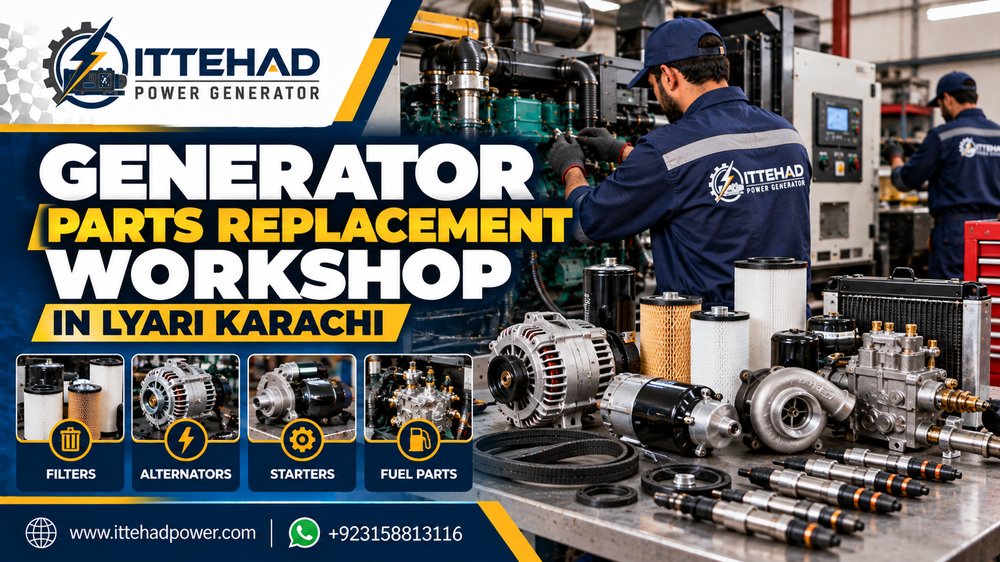
A professional generator parts replacement workshop in Lyari Karachi helps commercial and industrial generator users identify worn or failed components, confirm part compatibility, plan replacement correctly, and restore dependable generator operation without unnecessary component changes. Generator parts can fail because of age, heat, vibration, contamination, electrical stress, poor maintenance, or long operating hours. Correct replacement work should begin with diagnosis, followed by part identification, specification matching, safe removal, proper installation, and post-replacement testing so the generator can return to service with greater operating confidence.
Why Correct Generator Parts Replacement Matters
Replacing a generator part is not simply a matter of finding something that looks similar. Components can differ in size, electrical rating, pressure requirement, connector type, mounting arrangement, filtration specification, operating temperature, and compatibility with the generator engine or alternator.
An incorrect part can create poor fitment, leakage, unstable operation, electrical faults, or repeated failure. A careful workshop process helps ensure that the replacement component is suitable for the specific generator system.
Generator Parts Replacement Workshop in Lyari Karachi
A dependable generator parts replacement workshop in Lyari Karachi should combine accurate diagnosis, part identification, compatibility checking, replacement planning, safe installation, and final generator testing. The workshop should first confirm which component has failed and why before recommending replacement.
This approach can reduce unnecessary spending and help prevent the same problem from returning after a new part is fitted.
Start With Fault Diagnosis Before Replacing Parts
A symptom does not always identify the failed component directly. A generator that does not start may have a battery, starter, wiring, fuel, or control issue. Low voltage may involve the AVR, excitation, wiring, alternator, load, or engine speed.
Testing should therefore confirm the actual fault before parts are ordered or installed.
Useful Diagnostic Information
- Generator make and model
- Engine model
- Operating hours
- Exact fault symptoms
- Displayed warning or fault code
- Recent maintenance history
- Previously replaced parts
- Whether the fault appears under load
- Visible leakage, heat, noise, or vibration
Correct Part Identification
Part identification is one of the most important steps in generator repair. Workshops should use available part numbers, model information, electrical ratings, dimensions, connector types, and component specifications before confirming a replacement.
Information That Can Help Identify a Part
- Original part number
- Generator model
- Engine model
- Alternator model
- Electrical rating
- Mounting arrangement
- Connector type
- Physical dimensions
- Photographs of the original component
- Manufacturer markings
Part Compatibility Is More Important Than Appearance
Two generator parts can look almost identical while having different internal specifications. Filters, sensors, relays, AVR units, belts, pumps, and electrical components should not be selected only by visual comparison.
Compatibility should be confirmed before installation to reduce the risk of repeat faults or equipment damage.
Common Generator Parts That May Need Replacement
Different generator systems contain components that gradually wear or fail. Replacement requirements depend on generator design, maintenance history, operating hours, and actual fault condition.
- Fuel filters
- Oil filters
- Air filters
- Belts
- Hoses
- Battery components
- Starter components
- Fuel pumps
- Cooling-system components
- Electrical relays
- Sensors
- AVR components
- Breakers
- Cable lugs and terminals
- Alternator bearings
Generator Filter Replacement
Filters are routine service components, but replacement should still use the correct specification. Incorrect filtration or poor sealing can affect engine lubrication, fuel delivery, or airflow.
Fuel, oil, and air filters should be matched correctly and installed with clean sealing surfaces.
Fuel Filter Replacement
A blocked fuel filter can cause hard starting, power loss, unstable engine speed, or shutdown under load. If repeated filter blockage occurs, the fuel source and tank condition should also be investigated.
Replacing the filter without correcting contamination may provide only temporary improvement.
Oil Filter Replacement
The oil filter supports engine lubrication by removing contamination from circulating oil. It should be replaced according to operating hours, service intervals, and oil condition.
The correct filter specification is important for proper fit and lubrication-system performance.
Air Filter Replacement
A restricted air filter can reduce engine performance and increase combustion problems under load. The filter should be replaced when condition or service interval indicates it is due.
Air-intake connections should also be inspected for loose clamps, damaged hoses, or dust entry.
Generator Belt Replacement
Belts can crack, glaze, stretch, or lose tension after extended use. A worn belt can affect cooling-system operation and other belt-driven components.
Signs a Belt May Need Replacement
- Visible cracking
- Fraying
- Glazing
- Loss of tension
- Abnormal squealing
- Uneven wear
- Damaged belt edges
Generator Hose Replacement
Fuel and cooling hoses can deteriorate because of heat, vibration, age, chemical exposure, and pressure.
Swelling, cracking, leakage, hardening, softness, or damage around clamps can indicate that replacement is required.
Cooling System Parts Replacement
Cooling-system faults can involve hoses, clamps, belts, fans, pumps, thermostatic components, or other related parts depending on generator design.
The actual cause of overheating should be diagnosed before individual cooling parts are changed.
Fuel Pump Replacement
A weak fuel pump can cause hard starting, power loss, or fuel starvation under load, but similar symptoms can also result from blocked filters, air leaks, or damaged fuel lines.
Pump replacement should be based on confirmed performance problems rather than symptoms alone.
Starter Motor and Starting Parts
Starting faults can involve the battery, starter motor, relay, solenoid, wiring, or control signal. A workshop should test the starting circuit before replacing the starter itself.
This can prevent unnecessary replacement when the actual issue is a loose cable or weak battery.
Battery Replacement Planning
A battery should be replaced when testing confirms poor capacity, weak cranking ability, internal failure, or unsuitable condition for reliable generator starting.
Battery terminals, cables, and charging performance should also be checked so a new battery is not affected by an unresolved electrical problem.
Sensor Replacement
Generators may use sensors for temperature, oil pressure, speed, and other operating conditions. A faulty sensor can trigger incorrect readings or unnecessary shutdowns.
Sensor output should be compared with actual generator condition before replacement.
Relay and Control Component Replacement
Electrical relays and control components can develop burned contacts, weak operation, intermittent connection, or complete failure.
Testing should confirm the control signal and circuit condition before a relay is replaced.
AVR Replacement
The automatic voltage regulator is often suspected when generator voltage is low, high, or unstable. However, excitation faults, sensing problems, loose wiring, engine-speed issues, or alternator faults can create similar symptoms.
AVR replacement should therefore follow voltage, frequency, sensing, and excitation checks.
Breaker Replacement
A breaker may require replacement if internal contacts are damaged, the mechanism fails, terminals overheat, or testing confirms an electrical defect.
Repeated breaker trips do not automatically mean the breaker itself is faulty. Overload, short circuits, cable faults, or generator problems should also be investigated.
Electrical Terminal and Cable Lug Replacement
Overheated or burned cable lugs can create voltage drop, high resistance, and unreliable power delivery.
Replacement work should include checking cable condition, terminal surfaces, tightening method, and the reason overheating occurred.
Alternator Bearing Replacement
Alternator bearings can wear over time and create grinding noise, vibration, rough rotation, or excessive heat.
Bearing replacement should include inspection of shaft condition, alignment, housing, and nearby rotating components.
Signs That a Generator Part May Be Worn
- Repeated starting difficulty
- Unusual noise
- Increasing vibration
- Fluid leakage
- Overheating
- Visible cracking or wear
- Burned electrical connections
- Intermittent operation
- Reduced performance under load
- Repeated control-panel warnings
Wear Does Not Always Mean Immediate Replacement
Some components can show minor wear while remaining functional. Replacement decisions should consider actual condition, measurements, operating risk, service history, and expected future use.
A professional workshop should distinguish between parts that require immediate replacement and those that can remain in service with monitoring.
Replacement Planning for Critical Components
Critical components should be prioritized if failure could stop generator operation or create additional damage.
Replacement Planning Should Consider
- Current component condition
- Generator operating hours
- Importance of the affected system
- Availability of compatible parts
- Expected future operating demand
- Whether related components need inspection
- Testing required after installation
Replace the Root Cause, Not Only the Damaged Part
A failed component may sometimes be the result of another problem. A burned electrical terminal may be caused by looseness, an overheated belt may result from pulley misalignment, and a repeatedly blocked filter may indicate contamination.
The root cause should be corrected so the replacement component does not fail again prematurely.
Inspect Related Components During Replacement
When one part is removed, nearby components should be checked where appropriate. This can reveal related wear and reduce repeated workshop visits.
For example, hose replacement may also require inspection of clamps, fittings, and nearby heat exposure.
Correct Removal Procedures
Parts should be removed carefully to avoid damaging surrounding components, threads, connectors, wiring, or sealing surfaces.
Electrical, fuel, cooling, and rotating components may require different isolation procedures before removal begins.
Prepare the Installation Area
Before a new part is installed, mounting surfaces, connectors, threads, sealing areas, and nearby components should be inspected and cleaned as required.
Installing a new component onto a damaged or contaminated surface can cause leakage or poor fitment.
Use Correct Seals and Gaskets
Some generator parts require seals, washers, O-rings, or gaskets for proper installation. Reusing damaged sealing components can create leakage even when the main replacement part is correct.
Sealing components should match the repair requirement and be installed correctly.
Correct Tightening and Fitment
Overtightening can damage threads, housings, seals, or electrical terminals, while insufficient tightening can cause leakage or loose connections.
Parts should be installed according to suitable specifications and workshop practices.
Electrical Parts Need Correct Ratings
Electrical generator parts should match the required voltage, current, frequency, control signal, or protection rating.
Using an electrical component with an unsuitable rating can create unreliable operation or additional damage.
Mechanical Parts Need Correct Dimensions
Belts, bearings, hoses, mounts, and other mechanical parts must match the required dimensions and operating characteristics.
A small difference in size can affect alignment, tension, clearance, or connection reliability.
Reliable Parts Sourcing
Reliable sourcing means obtaining a compatible component with clear specifications and suitable quality for the generator application.
The cheapest part may not provide good value if it has uncertain specifications, poor fitment, or short service life.
Useful Sourcing Checks
- Correct part number
- Compatible generator or engine model
- Correct specification
- Suitable electrical rating where applicable
- Correct dimensions
- Proper connector type
- Condition of the supplied part
Verify Parts Before Installation
A replacement component should be compared with the original part before installation. Mounting points, connections, dimensions, ratings, and markings should be checked.
This can identify incorrect parts before time is spent fitting them.
Avoid Modifying Incorrect Parts to Make Them Fit
Forcing an incompatible component into place can create future reliability and safety problems.
If the replacement does not match the required specification or mounting arrangement, compatibility should be rechecked instead of modifying critical connections without proper engineering assessment.
Workshop Replacement Versus Temporary Repair
Temporary repairs can sometimes help with diagnosis or short-term movement, but damaged generator components should receive proper workshop repair or replacement before dependable operation is expected.
A permanent repair should address the actual failure and restore correct fit, sealing, electrical connection, or mechanical operation.
Testing After Parts Replacement
A replacement should always be followed by functional testing. The workshop should confirm that the new part works correctly and that the original symptom has been resolved.
Post-Replacement Checks May Include
- Starting performance
- Fuel, oil, or coolant leakage
- Operating temperature
- Voltage
- Frequency
- Battery charging
- Control-panel warnings
- Noise
- Vibration
- Electrical load response
Load Testing Where Appropriate
Some replacement parts can only be properly evaluated when the generator carries electrical load. Fuel, cooling, alternator, and electrical components may appear normal at idle but show problems when demand increases.
Controlled load testing can help confirm that the replacement performs correctly under realistic operating conditions.
Check for Leaks After Warm-Up
Hose, filter, pump, seal, and cooling-system repairs should be inspected again after the generator has warmed up.
Pressure, vibration, and temperature can reveal leaks that were not visible immediately after installation.
Check Electrical Connections After Replacement
Electrical parts should be inspected for secure connections, stable voltage, correct control response, and unusual heat after installation.
Loose terminals can damage even a correctly selected replacement component.
Check Noise and Vibration After Mechanical Replacement
After replacing bearings, belts, mounts, or other mechanical components, generator sound and vibration should be observed carefully.
New noise or vibration can indicate alignment, tension, fitment, or installation issues.
Benefits of Professional Generator Parts Replacement
- Better repair accuracy: Parts are replaced after fault confirmation.
- Reduced unnecessary cost: Serviceable components are not changed without reason.
- Improved compatibility: Replacement parts are matched to generator requirements.
- Reduced repeat faults: Related systems and root causes can be inspected.
- Improved reliability: Correct installation supports dependable operation.
- Better cost planning: Immediate and future replacement needs can be prioritized.
- Greater operating confidence: Generator performance is verified after replacement.
What Commercial and Industrial Generator Users Need
Commercial and industrial generator users need a workshop that can distinguish between maintenance items, repairable components, and parts that genuinely require replacement.
They also need clear information about compatibility, condition, replacement priority, and testing after installation.
How to Select a Generator Parts Replacement Workshop
A suitable workshop should provide more than basic part fitting. It should understand generator systems and be able to diagnose why a component failed.
- Ask whether fault diagnosis is performed before replacement.
- Confirm how part numbers and compatibility are checked.
- Ask whether related components will be inspected.
- Confirm that correct electrical or mechanical specifications are used.
- Ask whether replacement parts are verified before installation.
- Confirm that the generator is tested after replacement.
- Ask whether load testing is available where appropriate.
- Request practical guidance on future maintenance.
Avoid Choosing a Workshop Only by Replacement Cost
A low installation charge may not provide good value if diagnosis, compatibility checking, or post-repair testing is skipped.
The complete repair process should be considered, including whether the correct part is being installed and whether the cause of the original failure has been addressed.
Local Relevance in Lyari Karachi
Commercial and industrial generator users in Lyari Karachi may operate equipment under conditions involving heat, dust, vibration, long operating hours, and varying electrical demand. These factors can accelerate wear in filters, belts, hoses, electrical connections, bearings, batteries, and other generator components.
Access to a local parts replacement workshop can help users arrange inspection, part identification, compatibility verification, fitting, and post-replacement testing when generator reliability is important.
Heat and Generator Part Wear
High temperature can accelerate deterioration of hoses, belts, seals, electrical insulation, batteries, and certain control components.
Parts located near hot engine or exhaust areas should receive additional inspection when repeated failures occur.
Dust and Generator Components
Dust can shorten filter life, restrict cooling surfaces, contaminate electrical connections, and increase wear.
Generators operating in dusty environments may need more frequent inspection and consumable replacement.
Vibration and Component Failure
Generator vibration can loosen terminals, fittings, brackets, wiring, and clamps over time.
Repeated replacement of a loose or damaged component should lead to investigation of vibration, support, and mounting conditions.
Long Operating Hours and Replacement Planning
Frequently operated generators can reach component service intervals quickly. Belts, filters, batteries, bearings, and other wear items should be monitored according to actual operating hours.
Operating records can help predict replacement needs before complete failure occurs.
Standby Generators Also Need Parts Inspection
Low operating hours do not guarantee that every component remains in good condition. Batteries can weaken, hoses can age, seals can deteriorate, and electrical terminals can corrode during long periods of inactivity.
Standby equipment should therefore receive condition-based inspection even when runtime remains low.
Repeated Component Failure Needs Root-Cause Diagnosis
If the same part fails repeatedly, simply installing another replacement may not solve the problem.
Repeated belt damage, battery failure, filter blockage, burned terminals, or sensor faults should lead to investigation of the system conditions causing the repeated failure.
Keep Replaced Parts Records
Replacement history should be recorded as part of generator maintenance documentation.
Useful Information to Record
- Date of replacement
- Generator operating hours
- Part name
- Part number where available
- Reason for replacement
- Fault symptoms
- Related repair work
- Post-replacement test results
- Next inspection point
Plan Future Replacement Before Failure
Some wear items can be identified before they fail completely. Cracked belts, aging hoses, weak batteries, noisy bearings, and heat-damaged terminals may provide enough warning for planned replacement.
Planned work can reduce unexpected downtime and make parts sourcing easier.
Common Generator Parts Replacement Mistakes
- Replacing parts without diagnosis
- Selecting parts only by appearance
- Ignoring part numbers and specifications
- Using incompatible electrical ratings
- Failing to inspect related components
- Reusing damaged seals
- Ignoring the root cause of repeated failure
- Skipping post-installation testing
- Failing to check for leaks after warm-up
- Returning the generator to service without load verification where required
Trust Points for a Professional Parts Replacement Workshop
A dependable workshop should combine technical diagnosis, accurate part matching, careful fitting, and final generator testing.
- Fault confirmed before replacement
- Part number or specification verified
- Compatibility checked carefully
- Related components inspected
- Correct installation procedures used
- Seals and connections checked
- Electrical or mechanical operation verified
- Generator tested after replacement
- Load testing completed where appropriate
- Maintenance guidance provided
Guidance Before Taking a Generator for Parts Replacement
Providing complete generator and fault information can make workshop diagnosis and parts sourcing more efficient.
- Generator make and model
- Engine model
- Alternator model where available
- Operating hours
- Exact fault symptoms
- Displayed warnings
- Recent service history
- Previously replaced components
- Original part number where available
- Photograph or sample of the existing part where appropriate
Do Not Delay Replacement of Clearly Failed Parts
A failed hose, overheated terminal, damaged belt, noisy bearing, leaking fuel component, or weak critical electrical connection can lead to larger problems if operation continues.
Once failure is confirmed, timely replacement can help reduce secondary damage and unexpected generator downtime.
Post-Replacement Monitoring
Generator performance should be observed after replacement, especially during the first period of normal operation.
Watch for leakage, temperature changes, warning indicators, unusual sound, vibration, unstable voltage, or recurrence of the original symptom.
Maintain Reliable Generator Parts Performance in Lyari Karachi
A professional generator parts replacement workshop in Lyari Karachi should provide more than basic component fitting. Correct diagnosis, accurate part identification, compatibility checking, reliable sourcing, careful installation, and post-replacement testing are all important for dependable generator repair.
If your commercial or industrial generator has worn filters, damaged belts or hoses, weak starting components, faulty electrical parts, noisy bearings, leaking fuel or cooling components, or repeated component failures, arrange a professional workshop inspection in Lyari Karachi. Correct part selection, proper installation, and final performance testing can help restore reliable generator operation and improve long-term operating confidence.