
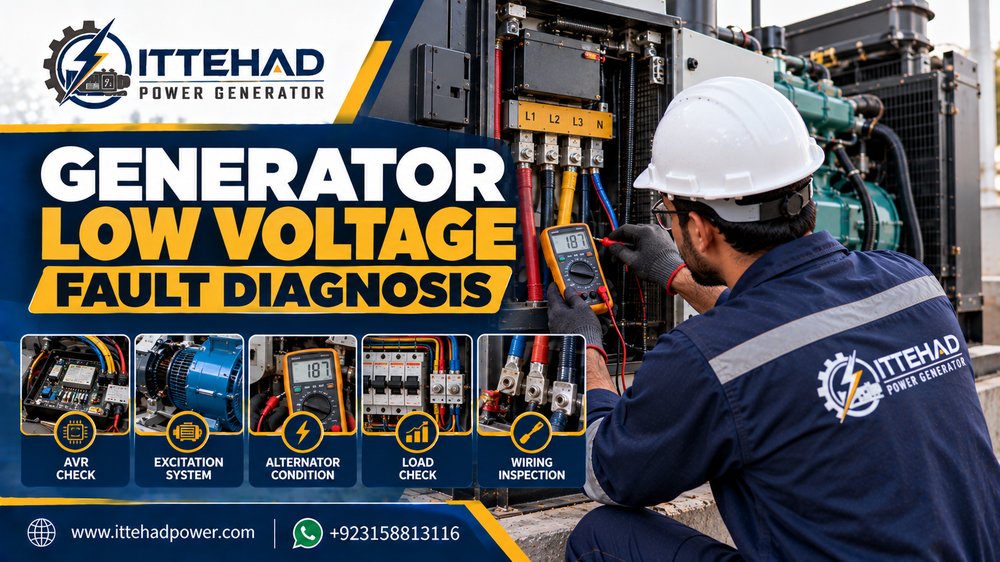
Accurate generator low voltage fault diagnosis helps commercial and industrial generator users identify why electrical output has fallen below the expected level and determine the correct repair approach before replacing components unnecessarily. Low generator voltage can result from AVR problems, weak excitation, alternator faults, excessive electrical load, incorrect engine speed, damaged wiring, loose connections, sensing issues, or other electrical conditions. A systematic inspection of voltage, frequency, load, excitation, alternator condition, wiring, and control components can help restore stable output and improve confidence in generator operation.
Why Generator Low Voltage Fault Diagnosis Is Important
A generator may continue running even when its electrical output is below the required voltage. This can create problems for connected equipment and may indicate that the generator itself is operating outside normal conditions.
Low voltage should therefore be investigated rather than accepted as a normal operating variation. Proper diagnosis helps determine whether the problem is related to electrical loading, engine speed, voltage regulation, excitation, alternator condition, or the connection between the generator and the load.
Common Signs of Generator Low Voltage
Low-voltage faults can appear in several ways depending on the generator configuration and the severity of the problem.
- Voltage meter showing lower than expected output
- Connected equipment receiving insufficient voltage
- Voltage dropping when electrical load is applied
- Generator output becoming unstable
- Lights or electrical equipment operating abnormally
- Repeated low-voltage warnings
- Breaker or protection-related interruptions
- Generator struggling as load increases
- Low voltage on one or more phases where applicable
Start Generator Low Voltage Fault Diagnosis With Basic Checks
A practical generator low voltage fault diagnosis should begin with the simplest operating checks before internal alternator or AVR components are tested. This reduces unnecessary repair work and helps narrow the fault systematically.
- Confirm the generator is running at normal operating speed.
- Check output voltage.
- Check operating frequency.
- Review the electrical load.
- Inspect breaker condition.
- Check accessible electrical connections.
- Review control-panel warnings.
- Inspect AVR and sensing connections.
- Evaluate excitation if required.
- Test alternator condition if external checks do not identify the fault.
Check Generator Engine Speed
Generator frequency and electrical output are linked to engine operating speed. If the engine is running slower than required, voltage and frequency may both fall.
Before assuming an AVR or alternator fault, confirm that the engine reaches and maintains the correct speed during operation.
Signs of Possible Speed-Related Low Voltage
- Low voltage together with low frequency
- Engine speed dropping as load increases
- Generator sound changing under load
- Unstable frequency readings
- Reduced engine performance
Check Generator Frequency
Frequency provides an important diagnostic clue. If both voltage and frequency are low, the problem may involve engine speed or excessive load rather than voltage regulation alone.
If frequency remains normal but voltage is low, attention can shift more strongly toward the AVR, excitation, sensing circuits, alternator windings, or electrical connections.
Excessive Electrical Load
A generator carrying more electrical demand than it can support may experience voltage drop. The engine may also struggle to maintain speed as load increases.
Load should be compared with generator capacity before electrical components are replaced. Reducing unnecessary demand can help determine whether low voltage is caused by overloading.
Possible Overload Indicators
- Voltage falls only when load is added
- Frequency also drops under demand
- Engine speed decreases
- Generator temperature rises
- Breaker trips occur
- Control panel shows overload warnings
Unbalanced Electrical Load
Where a generator supplies multiple phases, uneven loading can result in different voltage conditions across the output. One phase may carry significantly more demand than another.
Phase load should be reviewed where applicable, especially if low voltage appears only on part of the electrical system.
Automatic Voltage Regulator Problems
The automatic voltage regulator, or AVR, controls generator output by adjusting excitation. If the AVR is faulty or receiving incorrect sensing information, output voltage may remain below the required level.
Possible AVR-Related Symptoms
- Low voltage with normal frequency
- Voltage that cannot be adjusted correctly
- Unstable generator output
- Voltage changing unexpectedly
- Visible damage to AVR components
- Loose AVR connections
- Burned or overheated connectors
The AVR should not be replaced automatically. Sensing circuits, excitation components, wiring, alternator condition, and load should also be checked.
AVR Sensing Circuit Problems
The AVR relies on sensing information to regulate generator voltage. Loose, damaged, or incorrect sensing connections can cause the regulator to respond incorrectly.
Inspection should include sensing wires, terminals, connectors, and any signs of heat or corrosion.
Generator Excitation Problems
The alternator requires excitation to create the magnetic field needed for electrical generation. Weak or unstable excitation can result in low output voltage.
The exact excitation arrangement depends on alternator design, but faults may involve the AVR, exciter, rotating rectifiers, brushes and slip rings where applicable, wiring, or residual magnetism.
Weak Residual Magnetism
Residual magnetism can be important for the voltage-building process in some generator designs. If it is insufficient, the alternator may produce only a small voltage or fail to build normal output.
This condition should be confirmed through proper testing because several other faults can create similar symptoms.
Brushes and Slip Rings Where Applicable
Some alternator designs use brushes and slip rings as part of the excitation circuit. Worn brushes, contaminated slip rings, poor contact, or damaged connections can reduce excitation and contribute to low voltage.
These components should be inspected according to alternator design and maintenance requirements.
Rotating Rectifier Faults
Brushless alternators can use rotating rectifier components to support excitation. Failed diodes or related components may reduce field current and affect generator voltage.
Testing these components generally requires suitable electrical procedures and should be carried out by qualified personnel.
Alternator Winding Condition
Alternator windings can develop open circuits, partial shorts, insulation deterioration, or other internal faults that affect voltage production.
Winding problems are usually investigated after external causes such as loading, speed, AVR connections, and wiring have been reviewed.
Possible Winding-Related Signs
- Persistent low voltage
- Uneven phase voltage
- Abnormal alternator temperature
- Electrical smell
- Discolored winding areas
- Repeated electrical faults
- Abnormal resistance or insulation test results
Loose Electrical Connections
Loose terminals and cable connections can introduce resistance into the generator output path. This can create voltage drop, heat, and unstable electrical performance.
Alternator terminals, breaker connections, cable lugs, grounding points, and control wiring should be inspected for looseness, discoloration, corrosion, or damaged insulation.
Check Generator Output Breaker
A damaged or poorly connected output breaker can contribute to voltage loss between the alternator and connected load. Measuring voltage at appropriate points can help determine whether the drop occurs before or after the breaker.
The breaker should also be inspected for heat damage, loose terminals, and repeated tripping.
Cable Condition and Voltage Drop
Long cable runs, undersized conductors, loose cable lugs, or damaged connections can reduce the voltage received by connected equipment even when generator terminal voltage is acceptable.
Voltage measurements should therefore distinguish between voltage at the generator output and voltage at the load.
Inspect Generator Wiring
Control and power wiring can deteriorate through vibration, heat, moisture, abrasion, or previous repair work. Loose wires can also create intermittent low-voltage conditions.
Wiring Inspection Points
- Alternator output wiring
- AVR wiring
- Sensing connections
- Excitation wiring
- Breaker terminals
- Control-panel connections
- Cable insulation
- Grounding connections
Generator Voltage Low Only Under Load
If voltage is correct without load but falls significantly when electrical demand is applied, the fault may involve overloading, engine performance, fuel delivery, AVR response, alternator condition, cable sizing, or poor electrical connections.
Testing under controlled load can help identify which operating condition causes the voltage to fall.
Generator Voltage Low at No Load
If voltage remains low even when no significant electrical load is connected, attention should be given to engine speed, AVR operation, excitation, sensing circuits, and alternator condition.
This situation usually requires electrical measurements rather than load reduction alone.
Low Voltage on One Phase
Where applicable, low voltage affecting only one phase may indicate load imbalance, loose connections, winding problems, damaged terminals, or another phase-specific electrical fault.
Each phase should be measured and compared to determine whether the problem is isolated or affects the complete alternator output.
Low Voltage on All Phases
Low voltage across all phases may point toward generator speed, AVR, excitation, overall alternator condition, excessive load, or a shared electrical connection problem.
Frequency and load measurements become particularly useful when identifying the cause.
Why Systematic Diagnosis Matters
Low voltage can be caused by several different systems, and replacing parts without testing often increases repair cost without solving the problem.
A structured diagnostic sequence helps technicians eliminate possible causes one by one and identify the fault based on measurements and operating behavior.
Benefits of Accurate Generator Low Voltage Diagnosis
- Reduced unnecessary parts replacement: Components are changed only when testing supports the decision.
- Faster fault isolation: Voltage, frequency, load, and excitation checks narrow the problem systematically.
- Improved output reliability: The actual cause of low voltage can be corrected.
- Better equipment protection: Loose terminals, overload, and alternator problems can be identified before further deterioration.
- Reduced downtime: Structured troubleshooting can prevent repeated unsuccessful repairs.
- Improved maintenance planning: Findings can be documented for future service.
- Greater operating confidence: Output can be verified after corrective work.
What Commercial and Industrial Generator Users Need
Commercial and industrial generator users need stable electrical output and clear diagnosis when voltage falls below expected levels. They also need to know whether the problem is caused by the generator itself, electrical load, cabling, or downstream connections.
A professional technician should explain the identified cause, required corrective work, and any maintenance needed to prevent the fault from returning.
How to Select a Generator Low Voltage Troubleshooting Service
Generator low-voltage problems should be handled by technicians who understand engine speed, alternators, AVR systems, excitation, breakers, cabling, and electrical measurements.
- Describe when the low-voltage problem occurs.
- Explain whether it happens with or without load.
- Provide any control-panel warning information.
- Ask for voltage and frequency to be measured.
- Confirm that electrical load will be reviewed.
- Ask whether AVR and sensing circuits will be inspected.
- Confirm that excitation and alternator condition can be tested if required.
- Request post-repair voltage verification.
Do Not Adjust the AVR Without Diagnosis
Increasing AVR adjustment may temporarily raise voltage without correcting the actual cause. If low voltage results from incorrect engine speed, excessive load, poor sensing, winding problems, or damaged connections, AVR adjustment alone may not provide a reliable solution.
The cause should be identified before regulator settings are changed.
Do Not Replace the AVR Automatically
The AVR is often suspected when generator voltage is low, but it is only one possible cause. Replacing it without testing may leave the original fault unchanged.
AVR condition should be evaluated together with sensing, excitation, alternator output, load, and frequency.
Check Engine Performance Under Load
The generator engine must maintain suitable speed while carrying electrical demand. Fuel restriction, air-intake problems, mechanical issues, or overload can cause engine speed to fall.
If both frequency and voltage drop under load, engine performance should form part of the diagnosis.
Fuel System Problems and Low Generator Voltage
A generator engine that cannot receive sufficient fuel may lose speed as demand increases. This can reduce frequency and affect output voltage.
Fuel filters, supply lines, fuel quality, and other fuel-system conditions may therefore require inspection when low voltage appears mainly under heavier load.
Air Intake Restriction
Restricted airflow can reduce engine performance under demand. A heavily contaminated air filter may not create an obvious problem at light load but can become more noticeable as the engine works harder.
Air-filter condition should be considered when voltage and frequency fall together under load.
Generator Temperature and Electrical Output
Excessive heat can affect alternator, AVR, connections, and engine performance. If low voltage develops after extended operation, temperature should be reviewed together with electrical measurements.
Cooling and ventilation problems can sometimes contribute indirectly to voltage instability.
Alternator Overheating and Low Voltage
An alternator that is overheating may also show abnormal voltage or current behavior. Excessive load, winding faults, excitation problems, restricted airflow, or loose electrical terminals can affect both temperature and output.
Temperature and voltage should therefore be considered together during fault diagnosis.
Inspect for Burned or Overheated Connections
Heat-discolored terminals, melted insulation, burned cable lugs, or electrical smell can indicate high resistance at a connection point.
These faults should be corrected properly rather than simply tightened without checking the condition of the terminal and conductor.
Load Testing During Diagnosis
Controlled load testing can help show how voltage changes as electrical demand increases. This is useful when the generator appears normal at no load but develops low voltage during actual operation.
Voltage, frequency, current, temperature, and engine response should be monitored during testing.
Current Measurements and Load Assessment
Electrical current measurements help determine how heavily the alternator is being loaded. Where applicable, individual phase currents can also show whether loading is balanced.
Current should be compared with generator capacity and interpreted together with voltage and frequency.
Safe Electrical Testing
Generator voltage diagnosis can involve hazardous electrical energy. Live measurements, alternator testing, AVR checks, excitation testing, and internal electrical inspection should be performed by qualified personnel using suitable equipment and procedures.
Exposed terminals and energized conductors should never be handled casually during troubleshooting.
Local Operating Relevance for Low Voltage Problems
Generator electrical performance can be affected by actual operating conditions such as heat, dust, ventilation, long cable runs, high electrical demand, and extended operating periods.
Commercial and industrial generator users should therefore consider site conditions when investigating repeated low-voltage faults rather than evaluating the generator in isolation.
High Ambient Temperature
High surrounding temperature can increase engine and alternator heat, especially when the generator carries substantial load. Excessive heat may expose weaknesses in cooling, excitation, connections, or alternator condition.
Temperature should be monitored during low-voltage diagnosis where operating conditions are demanding.
Dust and Electrical Reliability
Dust can restrict cooling airflow and contaminate electrical areas. Over time, this can contribute to higher alternator temperature and reduced reliability.
Generator ventilation openings, alternator cooling paths, and electrical components should remain reasonably clean.
Long Cable Runs
Voltage measured at the generator may be acceptable while voltage at the connected load is lower because of cable length, cable size, or poor connections.
Both generator-terminal voltage and load-end voltage may need to be compared to identify where the voltage loss is occurring.
Trust Points for Professional Generator Low Voltage Diagnosis
Reliable troubleshooting should be based on measured conditions rather than assumptions.
- Voltage checked accurately
- Frequency reviewed
- Generator load assessed
- Engine speed considered
- AVR and sensing circuits inspected
- Excitation system assessed where required
- Alternator condition evaluated
- Electrical connections checked
- No unnecessary parts replacement
- Output verified after corrective work
Common Low Voltage Troubleshooting Mistakes
- Replacing the AVR without testing
- Adjusting voltage without checking frequency
- Ignoring excessive generator load
- Failing to compare no-load and loaded voltage
- Ignoring loose electrical terminals
- Overlooking cable voltage drop
- Failing to check excitation
- Ignoring engine-speed problems
- Skipping phase-by-phase measurements where applicable
- Returning the generator to service without final testing
Preventive Maintenance for Stable Generator Voltage
Routine maintenance can help identify conditions that may eventually cause low voltage.
- Check electrical connections periodically
- Monitor voltage and frequency
- Keep alternator ventilation clear
- Inspect AVR and sensing connections
- Maintain fuel and air filters
- Monitor generator load
- Check for overheating
- Record repeated voltage problems
- Inspect breakers and cables
- Test generator operation after maintenance
Keep Generator Low Voltage Repair Records
Low-voltage faults should be documented in the generator maintenance history. Record the symptoms, operating load, voltage and frequency readings, components tested, repairs completed, and final output results.
These records can help identify recurring faults and make future diagnosis more efficient.
Guidance When Generator Voltage Drops
If generator voltage falls below normal, note whether the problem occurs immediately, after extended operation, or only when additional load is connected. Also record frequency, warning indicators, temperature behavior, and any recent repair work.
This information can help the technician distinguish between load-related, engine-speed, AVR, excitation, alternator, wiring, and connection faults.
Verify Generator Output After Repair
After corrective work, the generator should be operated and checked for stable voltage and frequency. Testing should confirm that the problem does not return as load increases.
Where appropriate, terminal temperature, electrical current, engine response, and alternator condition should also be monitored.
Restore Stable Generator Voltage With Proper Diagnosis
Effective generator low voltage fault diagnosis requires a systematic review of generator speed, frequency, electrical load, AVR condition, excitation, alternator health, wiring, breakers, and cable connections. Identifying the actual cause before replacing components can reduce repair costs, prevent repeated faults, and restore more dependable electrical output.
If your commercial or industrial generator is producing low voltage, unstable output, phase imbalance, voltage drop under load, or repeated low-voltage warnings, arrange a professional electrical inspection. Accurate measurements, structured diagnosis, suitable corrective work, and post-repair testing can help restore stable generator performance and improve operating confidence.